Duration:
1 year (full-time)
Number of credits:
180
Start date(s):
September 2026
Expand, refine and articulate your unique vision of dance education.
We’ll empower you as a dance practitioner and educator to advance and innovate your teaching. You'll engage with current research, reflective practice, and practical, contextual and industry-based explorations, and graduate ready to lead and inspire within a range of contemporary dance education environments.
The programme integrates current pedagogies and facilitation practices, research and pedagogical frameworks, philosophy, practice as research, interdisciplinarity, and professional readiness, culminating in a final independent project focused on real-world application - a project that can go straight out in the industry.
Our graduates emerge as skilled dance educators, facilitators, and leaders with visionary skills to be change-makers for good. Through a dynamix mix of practical, contextual and industry-based learning, you'll expand your identity as a dance practitioner and prepare for a range of professional pathways - schools, businesses, community settings and professional dance contexts nationally and internationally.
We are committed to support individual dance practices and welcome students from a range of backgrounds and cultural perspectives. You will be encouraged to develop and test new ideas and skills in dance ‘laboratory’ situations critically to engage with the various cultural, social, and artistic contexts that shape pedagogy.
Dance, as a practice, is not merely about the physical embodiment of movement; it encapsulates a rich tapestry of history, identity, and expression that is influenced by a multitude of factors, including social and political contexts. Dance as an artform is community building, and you will consider this degree in an international and global context. Through informed and critical engagement with the current discourses in dance education and facilitation, our graduates explore holistic and inclusive approaches, with the potential to impact dance education in a wide range of contexts.


Modules
Module overview
These practical classes provide a framework for you to explore movement potential using a variety of approaches. Technical, performance, improvisational and interpretative skills are addressed using the interplay between action, imagination, observation and questioning.
You will be encouraged to reflect on your own practices as dancers and to find ways to explore detailed kinesthetic awareness through testing (trial and error) and to define how movement is experienced in relation to space, time and gravity. You will be involved in expressive and interpretative tasks in response to music, sound accompaniment or text and work with other dancers to locate synergies and sensitivity in your danced relationships.
You will experience a variety of practices as part of the portfolio. The approach and demands of each class will vary according to the interests and expertise of each tutor offering a range of experiences from within the professional field.
Teaching and learning
The delivery of this modules is four, one and half hour practical studio sessions per week.
There will be an additional 30 minutes of digital support per week. This will consist of audio-visual resources that accompany and support the practice delivery.
Teaching practice is aligned with the core principles of UDL and our philosophy is to be inclusive, respectful and accessible to all. Practical classes, workshops, peer review and tutorials. Peer review and critical feedback will be included in all sessions and tutorials can be booked during office hours.
Formative feedback is inherent in the delivery of a dance practice sessions and provided through manifold embodied perspectives covering the full range of learning styles, including physical/kinaesthetic, aural/auditory-musical, visual/spatial, verbal/linguistic, logical/anatomy-somatic, intra and interpersonal approaches.
Furthermore, every session involves tasks and/or mini projects which provide opportunities for peer and tutor feedback and formative learning.
Group and individual tutorials outside of the taught sessions offer opportunities to discuss individual interests, challenges and projects.
Assessment
This module will be assessed using a practical class 1 (30%) and a practical 2 (50%).
Module overview
This module interrogates practically and theoretically the question of what happens when we have a creative encounter. It investigates what happens when we have a creative encounter with others, such as established and novel lines of enquiry for dancers and performers; encounters in new settings in and outside of dance; and in and with institutions such as museums; work with and for different communities; and critical artistic engagement with past and present contexts.
It investigates how we might engage together in a creative practice and queries why a practice might be important, or excluding, or lean into an embodied, relational engagement necessary to create the work we are passionate about.
The module will explore topics that put the creative encounter front and centre, for example, leadership and collaboration, working with other professional artists and those who come to dance for the first time; delving into the topics of cultural heritage and community; institutional contexts and working through how we use creative practice to engage with topics such as care, socially engaged facilitation, audience relation, direction, producing, curating; showcasing topics connected to why we do this, for example to make an impact on health, empowerment, society, audiences, institutions, cultural engagement and interpretation; creating the ‘what if...’, using our imaginations to set up creative encounters as dance activists, artists, vision-makers of the future.
Teaching and learning
This is a year-long module, consisting of one, two-hour seminar, workshop or experiential laboratory per week.
The sessions will be a mixture of practical and theoretical engagement and indicated clearly to students.
There will be an additional 30 minutes of online digital support per week. This will consist of audio-visual resources will deepen understanding and support practice and thinking.
Assessment
This module will be assessed using a digital exposition (50%) and a project presentation (50%).
Module overview
This module develops the work studied in Dance Practice. Approaching Performance and will deepen technical and artistic understanding and their exploration of movement potential using a range of practices.
You will critically interrogate your technical knowledge of dancing and deepen your awareness of communicating movement. You will be involved in expressive and interpretative tasks in response to music, sound accompaniment or text and work with other dancers to locate synergies and sensitivity in their danced relationships. Focus will be on performative qualities alongside essential technical practice.
Via a performative presentation, you can demonstrate advanced performance skills and the problems and possibilities of ‘being seen’ (Deborah Hay) considering ‘dancing as an ensemble’ as well as the performer-audience relationship.
You will experience a variety of practices as part of the portfolio. The approach and demands of each class will vary according to the interests and expertise of each tutor offering a range of experiences from within the professional field.
Teaching and learning
This module consists of four, one and a half dance studio practice classes per week
Teaching practice is aligned with the core principles of UDL and our philosophy is to be inclusive, respectful and accessible to all.
Practical classes, workshops, peer review and tutorials. Peer review and critical feedback will be included in all sessions and tutorials can be booked during office hours.
Formative feedback is inherent in the delivery of a dance practice sessions and provided through manifold embodied perspectives covering the full range of learning styles, including physical/kinaesthetic, aural/auditory-musical, visual/spatial, verbal/linguistic, logical/anatomy-somatic, intra and interpersonal approaches.
Every session involves tasks and/or mini projects which provide opportunities for peer and tutor feedback and formative learning.
Group and individual tutorials outside of the taught sessions offer opportunities to discuss individual interests, challenges and projects.
There will be an additional 30 minutes of online digital support per week. This will consist of audio-visual resources that accompany and support the practice delivery.
Assessment
This module will be assessed using a practical dance class (50%) and a performative studio presentation (50%).
Module overview
This module invites you to interrogate artistic and performance practices, including your own modes of making, as forms of research discovery. It explores the relations between practice and different forms of codified and non-codified knowledge from the perspective of practitioners in dance, performance or other creative practices; and through exploration of concepts, theories and assumptions which underpin and inform performance.
Combining practice-as-research methodologies with philosophical enquiry, you will be challenged to deploy a range of critical research methodologies which combine the kinaesthetic, the self-reflective and the theoretical.
The module supports you to understand how artistic processes can be used to generate and embrace a multiplicity of conceiving, engaging and generating knowledges. Key topics include the nature of performance as art, epistemology, and the aesthetics and ethics of dance and performance, including the questioning of power structures within the field. These issues are examined through a combination of readings, discussions, practical tasks and embodied experiences, providing space to consider the cultural, political and ethical ramifications of performance practices in studio-based, classroom-based and hybrid settings.
Teaching and learning
This module is taught through a one, two-hour seminar and one, two-hour hybrid session per week.
Lecture and seminars will cover philosophical examinations of performance, while hybrid sessions interrogate the nature of artistic practices as a method of research.
There will be an additional 30 minutes of online digital support per week. This will consist of audio-visual resources will deepen understanding and support practice and thinking.
Assessment
This module will be assessed using a presentation (50%) and a blog (50%).
This module is one of the programme’s core compulsory modules for the MA in Dance Education. It builds upon the concepts and skills introduced in the modules Dance Practice, Thinking Through Performance, Creative Encounters and Approaching Performance. Drawing on existing knowledge, research and pedagogical understanding of dance education, it examines experiences of teaching and learning through dance practice to develop new practical teaching skills and support future professional approaches.
This module examines the landscape of current dance practice and the challenges of delivering classes and workshops across diverse global and cultural contexts. It offers you opportunities to examine and advance skills for safe, creative, and effective teaching of studio and workshop practice. You will engage with a range of educational theories and frameworks, reflecting critically on their own teaching practice and pedagogy. The module introduces practical teaching strategies designed to enhance skill mastery while fostering self-esteem, self-efficacy, and positive self-image in participants through inclusive practice.
Research from cross-cultural dance pedagogy, education, psychology, community dance, and somatic practice will inform teaching and learning strategies throughout this module. You will prepare for, experience, and deliver mentored classes and workshops, beginning with a comprehensive analysis of their own values and experiences. This foundational step is crucial for understanding individual teaching philosophies and the influence of cultural heritage on teaching styles. It leads to micro-teaching and progresses to longer, more complex delivery in a range of contexts.
How you'll learn:
This will be a Spring term module consisting of 1 x 2-hour lecture/seminar and 1 x 2 hours of practical in-studio session per week. The sessions follow a hybrid of practical and theoretical delivery and will be clearly indicated to students through timetabling and the weekly module schedule. There will be an additional 30 minutes of asynchronous digital support per week. This will consist of audio–visual resources.
This Independent Dance Education Project serves as the ‘exit’ module for the MA Dance Education programme. It is designed to encapsulate your learning throughout the programme, offer a presentation of where you see yourself as a dance educator, and assess your readiness to embark or re-embark on your professional career. The module provides opportunities for you to undertake independent practice research, culminating in a dance education project that reflects your research interests and extrapolates the dance education discourse you have encountered through the programme.
You will be encouraged to cultivate a professional, outward facing project that enables you to formulate a distinctive vision for advancing your practice. This module facilitates your exploration, envisioning and planning of dance education programmes, diverse curricula, workshop facilitation, and rehearsal methodologies. The module utilises and expands your existing knowledge and understanding of dance education by examining experiences of teaching and learning across broad dance contexts, while refining practical pedagogical skills and applying digital approaches through presentations.
You will be encouraged to criticise, re-examine, re-invent or disrupt the perspectives of dance education and to consider your implications for educators, learners, participants, and institutions, within the broad spectrum of dance education and cross-cultural pedagogy.
You will develop original research which is supported by tutorials, peer review and workshops. The module operates as a series of practical workshops, laboratory tasks, feedback sessions, seminars and tutorials. Key feedback points are scheduled to prepare you for independent work and to meet professional practice standards.
These are the current planned modules on this course and may be subject to change.
Career
Gain the practical, reflective and communication skills confidently to enter or advance within the arts industries.
The programme equips you with skills assessed through industry-based models, so you graduate prepared to enter the industry through multiple career pathways. Your final independent projects will be geared towards a product that can be applied straight to the industry, for example community workshops for vulnerable teenagers, a kathak practice for the elderly, a digital education and facilitation package for professional practitioners in choreography and curation, a dance on film series of workshops on climate change.
You can look forward to:
- Graduating with a portfolio comprising text, still and moving images, designed to effectively represent yourself to industry
- Industry guests run workshops on current professional projects inculcating working practice, language and social network
- Q&A sessions with industry guests that focus on key lessons for entering the industry
- The ability to locate and represent your specific practices, interests and skills within a cultural marketplace.
Your future could extend beyond performance roles. You’ll develop skills in communication, project management, and collaborative and feedback models, opening pathways into wider roles in the arts industry, from teaching and studio management, arts administration and producing to research and working in related arts fields.
Roehampton Dance staff have expertise in a vast variety of dance education and facilitation aspects from global and decolonial practices, choreographic and curatorial, community practice, screendance, etc, and through this, you will gain practical and theoretical knowledge, information and connections.
Staff enjoy strong relationships with a very wide range of international dance artists, companies, choreographers, producers, funders and more. They share their experiences of establishing such relationships through teaching, guest contributions, and wider industry opportunities like student access to workshops, festivals and performances.
Learning and assessment
How you'll learn
You’ll expand, advance and apply skills that will prepare you for professional life.
The programme is highly practical, and you’ll be learning in:
- Specialist studios
- Seminar rooms
- Digital labs
- Theatres and site-specific locations.
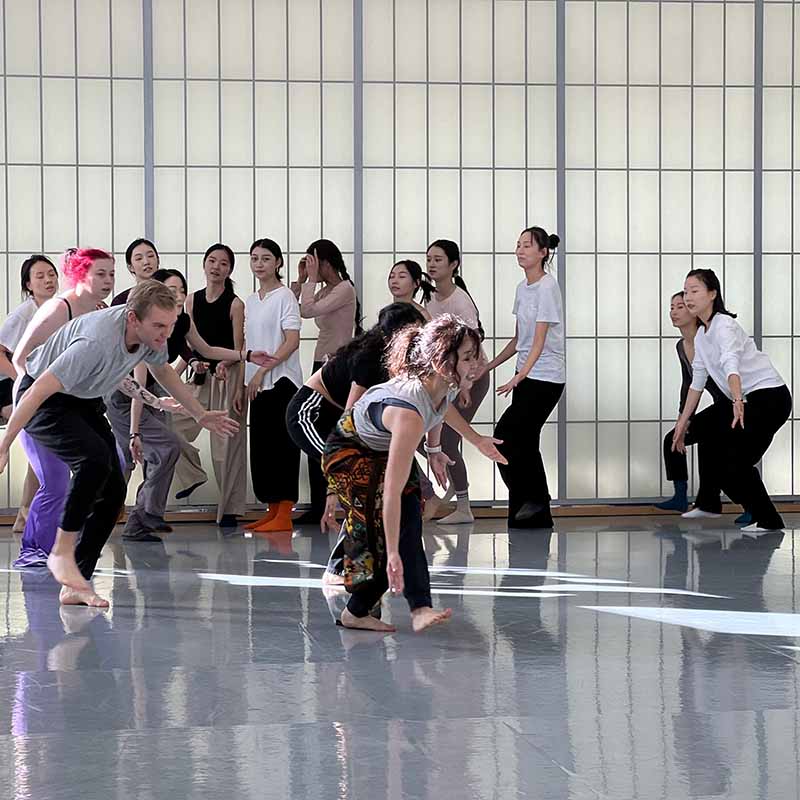
In the studio, you’ll develop advanced technical and creative skills through exploration, collaboration, and independent investigation. You’ll be encouraged to experiment, exchange ideas, and engage in flipped classroom approaches where your own practice and research inform group learning.
Learning takes place through a mix of digital and live formats, including performances, presentations, and digital portfolios. You’ll receive individual tutorials in every module, with tailored mentoring as part of your Independent Dance Education Project.

How you'll be assessed
Assessment on the MA Dance Education is designed to reflect real-world professional practice and support your development as an artist, educator, and researcher.
You’ll experience a range of inclusive, practice-based and written assessments that help you demonstrate creativity, critical thinking, and professional readiness. This includes:
- Practical demonstrations of embodied knowledge, performances, and facilitation tasks
- Digital and creative projects, including online content and portfolio work
- Written reflections, blogs, and critical essays connecting theory and practice
- Group projects and peer feedback models that develop collaborative and evaluative skills.
The programme is a collaborative dialogue between staff and your fellow students, and you’ll be invited collectively to discuss and re-write assessment criteria, and key roles are taken on by students to organise some practical assessments, such as planning workshop schedules, and curating the running order of teaching experiences.
Course staff
You will be taught by artists and researchers who are leading specialists in their fields and provide an excellent springboard for you to thrive in your career in dance and the arts.
Dr. Chi-Fang Chao
Dr. Chi-Fang Chao specialises in dance anthropology and dance ethnography. She has studied dance cultures in several Asian regions, such as Taiwan, Okinawa and the latter’s diaspora communities. Her major research interests include ritual, spirituality and embodiment, and indigenous dance theatre in the post-colonial era.

Dr. Nicola Conibere
Nicola Conibere is a choreographer and academic. Her research uses choreographic practices to explore the potentials of how bodyminds relate. She is interested in the politics of performance and the potentials of spectatorial exchange: her work often investigates theatricality, public appearing and social choreography.

Hanna Gillgren
Hanna Gillgren (SE) is choreographer and curator for H2DANCE and Fest en Fest an artist-run festival for expanded choreography for UK and Nordic-based choreographers. She is part of the inaugural artistic cohort at Rose Choreographic School Sadler’s Wells East London (2024-26).

Professor Sara Houston
Sara is an award winning researcher and teacher. She won the BUPA Foundation Prize in 2011 for her pioneering work in dance and Parkinson’s. In 2014 she was a Finalist in the National Public Engagement Awards for her work engaging the general public in her Parkinson’s and dance research.

Professor Alexandra Kolb
Alexandra has lectured at universities and conservatoires in the UK and internationally, following her Ph.D. from Cambridge University. She draws on a background in Literature, Art History and Philosophy alongside Dance and Theatre to convey to her students a sense of the dance field’s breadth and its many overlaps with other artistic and scholarly developments.

Lalitaraja
Lalitaraja (Joachim Chandler MA) is a dance artist, educator and Feldenkrais practitioner based in the dance department at Roehampton University where he teaches choreography, contact improvisation and improvisation. As a performer he has worked with Scottish Ballet, Michael Clark, Adventures in Motion Pictures, Laurie Booth, Yolande Snaith and Charles Linehan among others.

Dr. Heike Salzer
Heike Salzer is a German dancer and artist-scholar. She fluidly moves between performance, choreography, and site specific screendance. In 2014 she founded WECreate Productions together with Ana Baer Carrilllo (US/MX) jointly directing award winning screendances, installations and multi-media performances that have been encountered by thousands of audiences in Asia, Europe, Middle East and the Americas.

Dr. Tamara Tomić–Vajagić
Dr. Tamara Tomić–Vajagić works across visual culture, digital media, and performance and is a Senior Lecturer in Dance Practices. She teaches across undergraduate and postgraduate degrees as well as researches and supervises doctoral projects on the themes of dance and visual art, mediated choreography, and dance history, aesthetics, and performance studies.

Mike Toon
Michael Toon trained at the Legat School and Urdang Academy before performing with London City Ballet, Vienna Festival Ballet and as an international freelance soloist. Alongside his stage career he co-founded Capitol Chamber Ballet Project and Heart of the Jester Productions, creating opportunities for collaboration between dancers, musicians and technicians.

Dance spaces and studios
Large state-of-the-art, purpose-built dance and teaching spaces, designed for dance classes, workshops and movement exploration. Equipped with highly-sprung harlequin floors and underfloor heating.
A dedicated, well-equipped dance studio, perfect for practical dance classes and rehearsals. Equipped with highly-sprung harlequin floors, and a large TV for presentations.
Modern and accessible teaching space supporting dance theory, workshops and rehearsals.
Multipurpose hall, used for workshops, rehearsals and choreographic sharing.
Large and historic (18th-century) room used for teaching, special events and occasional performances.
Professionally rigged 350-seat theatre providing a first-rate performance venue for showcases and productions. Equipped with highly-sprung harlequin floors. Used for teaching, rehearsals and performance.
High-quality dance studio equipped with technology for rehearsals, choreography development, installations, and interdisciplinary creative practice. Equipped with highly-sprung harlequin floors and lighting rig.
Computer labs with extensive software for audio-visual editing of film and sound, and a 95-seat cinema.


Open days
Get a real taste of our campus, community and what it’s like to study at Roehampton
Applying
Full-time UK postgraduate students apply through our direct application system.
Specific entry requirements
UK 2:2 or above, or equivalent
A personal statement revealing their previous history of dance training, and their interest in developing their dance education practice.
General entry requirements
September 2026 entry tuition fees (UK)
| Level of study | Full-time |
| MA | TBC |
We offer a wide range of scholarships and bursaries. See our financial support pages for UK students.
We also provide other ways to support the cost of living, including on-campus car parking, hardship support and some of the most affordable student accommodation and catering in London. Find out more about how we can support you.
International undergraduate students apply through our direct application system.
Specific entry requirements
UK 2:2 or above, or equivalent
A personal statement revealing their previous history of dance training, and their interest in developing their dance education practice.
General entry requirements
September 2026 entry tuition fees (international)
| Level of study | Full-time |
| MA | TBC |
We offer a wide range of scholarships and bursaries. See our financial support pages for international students.
We also provide other ways to support the cost of living, including on-campus car parking, hardship support and some of the most affordable student accommodation and catering in London. Find out more about how we can support you.

Need help or advice before applying?
Arts, Humanities and Social Sciences
Integrating the creative dynamism of arts and digital industries with the deep-rooted traditions of humanities and social sciences.