
Entry tariff:
2027/28 entry: 112–128 UCAS points (or equivalent)
When we consider applications to study with us, we form a complete view of your achievements to date, and future potential through our contextual offers.
UCAS Code:
To apply for Roehampton campus, add B740 (no additional codes needed)
To apply for Croydon University Centre: on your UCAS application select campus code 'C' when adding Roehampton (R48) and BSc Adult Nursing (B740)
Start date(s):
February 2027
September 2027
Join a community committed to shaping the future of healthcare through skilled, compassionate practice.
Our BSc Adult Nursing course prepares you to deliver safe, high quality care in both community settings and hospitals, helping people to maintain health and manage illness across adult life.
You will build strong professional foundations from the start, supported by clinicians and academics with extensive experience across the sector. This degree develops your understanding of:
- How the body functions
- How to promote physical and mental wellbeing
- How to support people with both acute and long term conditions
This course has entry points in February and September. See our Applying section for how to apply.

Did you know?
On successful completion of the course, you will be eligible to apply for registration with the Nursing and Midwifery Council, opening the door to a rewarding and meaningful career in adult nursing.
During your three years of study, you will work towards meeting the Nursing and Midwifery Council standards of proficiency for registered nurses.
You will also develop the values central to the NHS Constitution, including person centred care, compassion, dignity and respect, and professional responsibility.
You will examine the evolving landscape of modern health services and the increasing emphasis on integrated care within the community. Throughout your course, your confidence in communication, clinical reasoning and decision making will grow, equipping you to work effectively with people from diverse backgrounds.
Your professional skillset will encompass health assessment, holistic care planning, evidence based practice, clinical skills, medication management, communication skills, teamwork and leadership.
Top 3 in London for student satisfaction
Complete University Guide 2026

#1 in London for student life
WhatUni Student Choice Awards 2026
Module details: In this module, you will build the foundations you need to succeed in Higher Education and begin your journey as an Adult Nurse. You will develop key academic abilities, including writing, literature searching, referencing, and digital literacy, helping you use learning technologies with confidence. Core nursing theory will strengthen your understanding of professional relationships, assessment, person centred care, and the policies that guide safe and accountable practice. Through seminars, workshops, digital activities, and support from staff and service users, you will apply your learning to real case studies and reflective tasks, preparing you to think critically and act with integrity.
The aim of this interprofessional module is to introduce you to the key concepts and core foundations for the scientific study of life. A strong interprofessional ethos is built by bringing you and other students together and creating the opportunity to interact with and learn alongside students from a breadth of professional programmes. Subsequent modules will build on and integrate the strong foundations gained through this module to support the development of required profession specific knowledge and skills. You will develop a solid understanding of the structure and function of living organisms through the study of anatomy and physiological systems relevant to your programme of study. You will explore core physiological principles across the lifespan and, where appropriate, examine deviations from normal function, including aspects of pathophysiology.
How You'll Learn: You'll learn through practical sessions and workshops, lectures, online asynchronous tasks, and tutorials.
Module details: In this module, you will explore the principles that underpin public health, health promotion, and illness prevention, focusing on how nurses help improve population wellbeing. You will examine social determinants, sustainable approaches to care, and the use of evidence and digital tools to enhance safety and quality. Learning activities will include lectures, seminars, discussions, case studies, and community focused tasks that deepen your understanding of health inequalities and prevention strategies. Through a written assignment centred on a health promotion campaign, you will apply theory to practice and build the knowledge and confidence needed to contribute to equitable, effective care in diverse settings.
Module details: In this module, you will begin developing core nursing capabilities through an integrated blend of placement learning and simulation. You will work with service users and professionals in diverse settings while holding supernumerary status so you can focus on your development. Preparation through online study, workshops, and skills sessions builds confidence for practice. You will take part in immersive simulations, virtual reality activities, and collaborative exercises informed by service users. Guided reflection supports your understanding of the NMC Code and current standards. Key themes include communication, safety, assessment, teamwork, dignity, and planning care, with all practice hours contributing to registration requirements.
These are the current planned modules on this course and may be subject to change.
Please note that these modules are subject to validation by the Nursing and Midwifery Council (NMC).
Module details: In this module, you will develop the skills needed to recognise and manage acute deterioration in adults across both physical and mental health contexts. You will apply your understanding of anatomy, physiology, pathophysiology, and pharmacology to structured A to E assessment and safe clinical decision making. Key emergencies, including airway and breathing problems, circulatory issues, stroke, diabetic crises, and acute mental health decline, will be explored alongside evidence based interventions. Through lectures, workshops, and simulation, you will strengthen communication, assessment, and escalation skills. A practical OSCE will assess your ability to respond to an unwell adult and propose appropriate next steps in care.
Module details: In this module, you will deepen your understanding of long term conditions within a rapidly evolving health landscape shaped by new national strategies. You will explore how biopsychosocial factors influence recovery and how evidence based pharmacological and non pharmacological approaches support effective management. Learning will focus on partnership working with the MDT, individuals, and carers to promote independence, healthy choices, and self management. Through workshops, seminars, online study, and interactive activities, you will examine common conditions and co morbidities and consider lived experiences. A case study assessment will consolidate your knowledge and prepare you for future nursing practice.
Module details: In this module, you will strengthen your research abilities through interprofessional learning that brings together students from a range of health and social care programmes. You will build confidence in appraising quantitative, qualitative, and mixed methods evidence, while exploring research design, ethics, and data analysis in relation to person centred care. Guided activities will develop your literature searching and synthesis skills, preparing you to plan a future scoping review. You will also examine digital healthcare and the ethical use of AI in research. The knowledge and scholarly thinking gained will support your wider academic work and future professional development.
Module details: In this module, you will advance the practice foundations established earlier by applying core nursing skills to more complex scenarios in both placement and simulation settings. You will prepare through online study, workshops, and clinical skills sessions that develop assessment, diagnostics, medicines management, and care planning. Learning will include immersive and virtual simulations, as well as Forum Theatre informed by service users and carers. Revisiting earlier case studies with added complexity, you will explore human factors, delegation, de escalation, mental health assessment, end of life care, recognising deterioration, and emergency response, strengthening confidence and competence across the NMC proficiencies.
These are the current planned modules on this course and may be subject to change.
Please note that these modules are subject to validation by the Nursing and Midwifery Council (NMC).
Module details: In this module, you will develop the insight and capability needed to support people with complex health and social care needs across secondary and tertiary settings. You will examine integrated and person centred approaches, exploring how legal standards, policy, and service user involvement shape coordinated care. Learning activities will help you assess needs, plan interventions, and work across professions to promote safe continuity. You will consider strategic shifts towards community focused practice and digital health. Through real scenarios and simulation, you will strengthen clinical reasoning, ethical decision making, and collaborative skills for inclusive, accountable nursing practice.
Module details: In this module, you will strengthen your readiness to move from student to registered nurse by deepening your understanding of accountability, legal requirements, and ethical practice. You will develop confidence in leading and coordinating care, managing patient groups, and using safe prioritisation and delegation strategies. Learning in class will complement your experiences in practice as you build your supervision and feedback skills and refine your approach to leadership within interprofessional teams. You will also prepare for your first post through focused career development activities. Your progress will be demonstrated through a professional portfolio that evidences reflection, growth, and clinical insight.
Module details: In this module, you will apply your theoretical knowledge to real-world challenges through independent and collaborative projects. You will identify a need within your discipline, gather and evaluate evidence, and use critical thinking to plan, develop, and implement a capstone project. Building on problem-solving, research, and communication skills gained throughout your programme, you will deliver a project that is relevant to your field, which may include community initiatives, innovation, or quality improvement. All projects are designed to meet programme-specific and professional standards, enabling you to demonstrate practical application of your learning and readiness for future professional practice.
Module details: In this module, you will consolidate your learning and prepare for professional practice through placements and simulated learning that reflect the full scope of the NMC proficiencies. You will refine core clinical abilities with increasing complexity, including assessment, history taking, diagnostics, care procedures, leadership, and medicines management, supported by updates to mandatory training. Through varied simulation methods, you will revisit and integrate earlier case studies while exploring themes such as speaking up, difficult conversations, bereavement, patient safety, duty of candour, and leading care. This experience will strengthen your confidence to practise independently under indirect supervision as you move towards registration.
These are the current planned modules on this course and may be subject to change.
Please note that these modules are subject to validation by the Nursing and Midwifery Council (NMC).
£5000 NHS Bursary
We are committed to helping you succeed, and that includes easing the financial pressures of training for a career in nursing.
Home Nursing students receive a non-repayable NHS payment of £5,000 each academic year, with further funding available for eligible circumstances.
This support can make a real difference while you focus on developing your skills and preparing for a fulfilling career.
Careers
We take pride in preparing nurses who are confident, capable and ready to step into roles that make a genuine difference.
Employers value the strong clinical, professional and interpersonal skills that our graduates bring, and many go on to become leaders within the profession.
A BSc Adult Nursing from Roehampton opens doors to a wide range of career paths across health and social care, including roles in:
- Community nursing teams such as District Nursing, Health Visiting and School Nursing
- General Practice Nursing
- Care homes
- Hospices
- Rehabilitation centres
- Hospitals including wards, A&E, ITU, theatres and outpatient departments
- Prisons and custody units
- Specialist teams such as Respiratory, Oncology and Tissue Viability
- Research
- Education
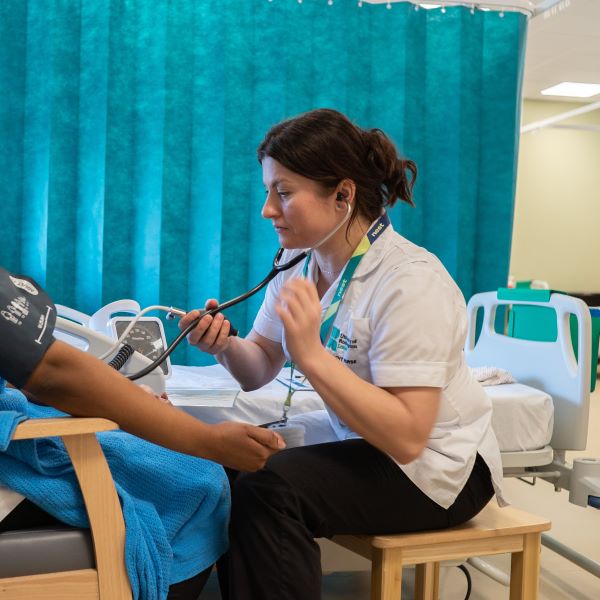
The Student Futures team is here to support you throughout your time at Roehampton and beyond.
They offer services tailored to your needs, helping you take confident steps towards your future.
You’ll have access to a wide range of career workshops and events, where you can engage with employers and develop the skills you need to succeed in the workplace.
These opportunities will help you build your CV, prepare for interviews, and connect with successful Roehampton graduates who are thriving in their careers. You’ll also be able to engage with our partners across London and beyond.
Wherever you want to go in the future, you'll be preparing for the world of work from your very first day.
Our graduates' salaries grow faster than the UK average
Longitudinal Education Outcomes 2026

Take the next step towards your nursing career
A nursing degree can prepare you for a rewarding career across hospitals, community healthcare, specialist practice, research, leadership and more. See how Roehampton graduates are putting their skills into practice.
“One of the most valuable lessons from my placement was the importance of networking.”
Kittanya, BSc Adult Nursing graduate, Registered Nurse at Croydon Hospital

Learning & assessment
How you’ll learn
Your training combines classroom study with immersive practical experience, giving you the confidence to apply your knowledge in real clinical environments.
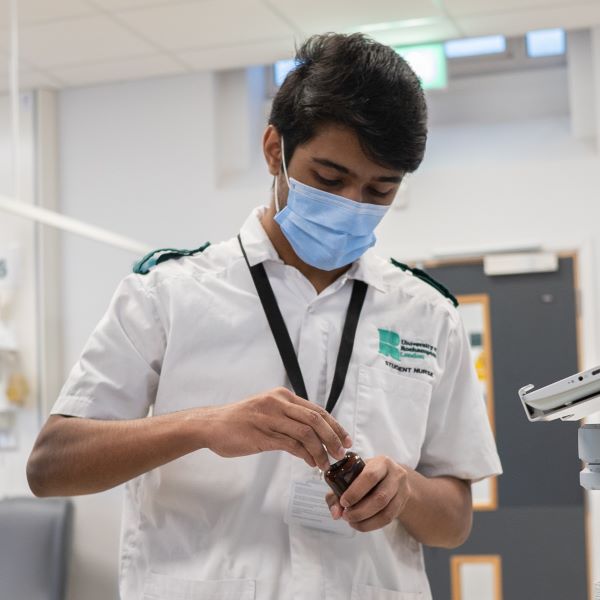
Teaching takes place in modern learning spaces and our Clinical Simulation Centres, where you can safely develop and refine your skills under the guidance of experienced academics and sector professionals. Your learning will include lectures, seminars, group work, online learning and reflective practical exercises.
You will study the full picture of adult health, giving equal emphasis to physical and mental wellbeing so that parity of esteem becomes central to your approach to care. You will also work alongside healthcare professionals from a range of disciplines, helping you develop a broad understanding of modern nursing.
This includes understanding the role of nursing within 21st century health and care services, the move towards integrated community care highlighted in the NHS Long Term Plan, the importance of evidence based practice in keeping people safe, and the value of building strong professional relationships with those you care for and collaborate with.

How you’ll be assessed
You will be assessed through a combination of academic and practice-based tasks designed to reflect real nursing responsibilities.
These include:
- Reflective and case study-based assignments
- Exams
- Presentations
- Safety and quality enhancement projects
Your clinical ability will be assessed through simulation-based activities in our Clinical Simulation Centres, where you can demonstrate your skills in a controlled setting.
During your placements, both clinical and academic staff will evaluate your performance and professional development, ensuring you are progressing confidently towards becoming a registered adult nurse.
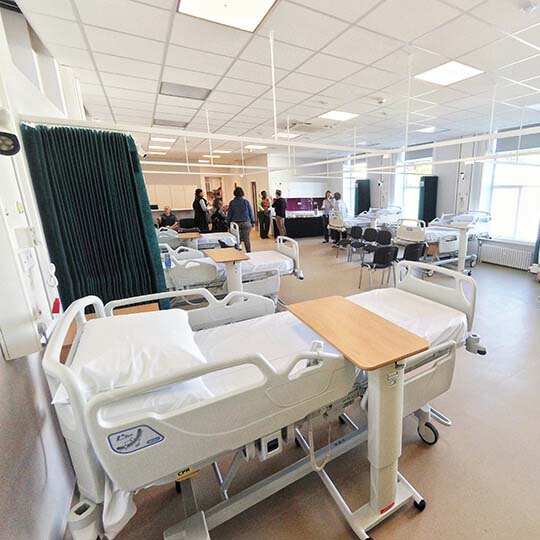
Hands-on learning in world-class facilities
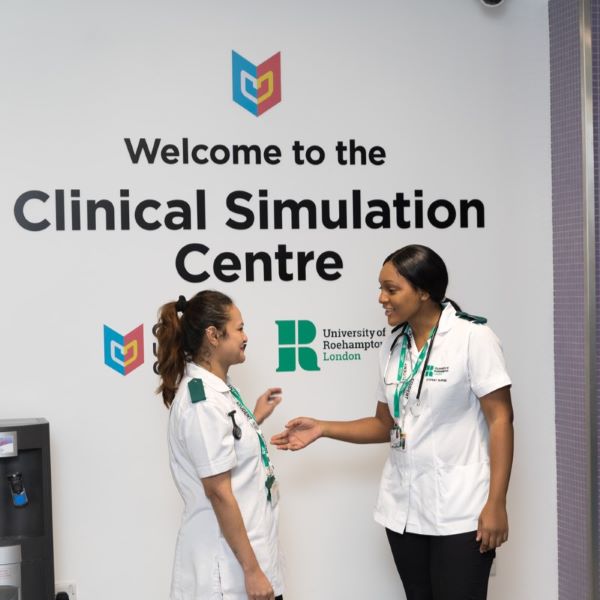
Your training takes place in the modern, purpose built Clinical Simulation Centre at Froebel College, designed to build your confidence and competence in real clinical scenarios. You will practise key skills alongside fellow students, service users, carers, role players and high-tech patient simulators.
The centre includes the Froebel Ward, a fully functional six-bed hospital ward, along with mock consulting rooms, patient homes and a simulated apartment, all equipped with advanced technology and video streaming to support learning and feedback.
You will also use the Mary Seacole Health Innovation Centre at Digby Stuart College, a leading multi-disciplinary hub for primary and community care. These facilities provide a supportive, realistic environment to develop your skills before applying them on real-world placements.
Study this course at Croydon University College
Our nursing degrees are delivered at Croydon University Centre, allowing you to study in a location that fits your lifestyle.
This flexible option means you can access high quality teaching, support and facilities while staying connected to your local community.
It is an ideal choice if you want the full Roehampton experience with the convenience of learning closer to home.
Gain real world skills on placement
Professional placements are a core part of your training, giving you the experience and confidence to step into your first role as a registered nurse.
Our placement network includes:
- St George’s University Hospitals
- Kingston Hospital
- Epsom and St Helier Hospitals
- Croydon Health Services
- Imperial College Hospitals
- London Northwest University Healthcare Hospitals
- North Middlesex University Hospital
- Your Healthcare
- Hounslow and Richmond Community Healthcare
- Sutton Health and Care
- Croydon Health Services
- Surrey Heartlands
Across Sutton, Kingston, Richmond, Croydon, Merton and Wandsworth Training Hubs
- Southwest London and St George’s Mental Health Trust
- The Priory
- Holybourne Hospital
- Blackheath Rehabilitation Centre
- Princess Alice Hospice
- St Raphael’s Hospice
- Trinity Hospice
- Royal Hospital for Neurodisability
- Local care homes
Throughout your course, you will work with a wide range of placement partners, allowing you to develop practical skills in varied clinical environments and understand the full landscape of modern healthcare
You can also arrange an elective placement abroad, giving you the chance to broaden your experience and learn within a different healthcare system.
Open days
Get a real taste of our campus, community and what it’s like to study at Roehampton
Entry requirements
Entry tariff
2027/28 entry: 112–128 UCAS points (or equivalent)
Looking to work out your UCAS points or find out about our entry requirements? Find out more.
When we consider applications to study with us, we form a complete view of your achievements to date, and future potential, and can offer flexibility in entry requirements. Find out more about our Contextual Offer scheme.
Specific entry requirements
A levels/BTEC (or equivalent qualification): at least one science or health-related subject.
GCSE (or equivalent) grades 4/C in Maths and English (at least one science subject desirable).
Applicants will also undertake an interview. Successful applicants will need to complete an Occupational Health (OH) Check and an enhanced DBS (Disclosure and Barring Service) Check.
General entry requirements
Entry tariff
2027/28 entry: 112–128 UCAS points (or equivalent)
Looking to work out your UCAS points or find out about our entry requirements? Find out more.
When we consider applications to study with us, we form a complete view of your achievements to date, and future potential, and can offer flexibility in entry requirements. Find out more about our Contextual Offer scheme.
Specific entry requirements
A levels/BTEC (or equivalent qualification): at least one science or health-related subject.
GCSE (or equivalent) grades 4/C in Maths and English (at least one science subject desirable).
Applicants will undertake an interview. Successful applicants will need to complete an Occupational Health (OH) Check and an enhanced DBS (Disclosure and Barring Service) Check.
Non-native English speakers who do not have GCSE English or equivalent at grade 4/C or above require an IELTS score of at least 6.5 in writing and at least 7.0 in reading, listening and speaking, with a minimum overall score of 7.0. Please refer to the NMC website for more details.
General entry requirements
Apply now
Applying to Roehampton is straightforward, and we're here to guide you through every step and answer any questions you might have.
If you currently live in the UK or Ireland, you can apply directly through UCAS. Check out our UCAS application guide for all the information you need.
If you live in the UK and already have all your exam results, you can apply to us directly.
If you’re an international student, you can apply to us directly or add Roehampton as a choice on your UCAS application. Check out our guidance for international students for more information.
If you have any questions or need some support, reach out to us.
Fees and funding
UK students
Tuition fees
| Entry date | Undergraduate Year 1 |
|---|---|
| September 2026 | £9,790 |
| February 2027 | £9,790 |
Prices shown are for the first year of your degree.
Funding your studies
We also provide other ways to support the cost of living, including on-campus car parking, hardship support and some of the most affordable student accommodation and catering in London.
International students
Tuition fees
| Entry date | Undergraduate Year 1 |
|---|---|
| September 2026 | £20,280 |
| February 2027 | £20,280 |
Prices shown are for the first year of your degree.
Funding your studies
We also provide other ways to support the cost of living, including on-campus car parking, hardship support and some of the most affordable student accommodation and catering in London.

Need help or advice before applying?
Life and Health Sciences
Join our diverse Life and Health Sciences community, whose leading academics are dedicated to understanding and improving the living world through ground-breaking advances in scientific research.


