You'll need:
2027/28 entry: 112–128 UCAS points (or equivalent)
2027/28 entry: Foundation Year: 64–80 UCAS points (or equivalent)
International Foundation Pathway:
64 UCAS (or equivalent)
IELTS: 5.5
UCAS Code:
V100
V101 (If choosing Foundation Year)
Start date(s):
September 2027
Our History degree is modern, inclusive and relevant. Its contemporary focus helps you to navigate the pressing cultural, environmental, social and political challenges facing us today.
You’ll discover how people, ideas, and events have shaped societies across time, and investigate themes such as power, identity, conflict, belief, and social change.
Why choose Roehampton?
- Focusing on the period since 1800, you’ll examine the cultural, political and environmental forces that continue to influence societies across the globe.
- Discover that History is never finished or fixed: it evolves constantly, generating new questions, new methods, and lively public debate about the stories nations tell about themselves.
- Explore how History is recorded, interpreted, and represented, and engage directly with external practitioners working in heritage, museums, archives, libraries, media and other history-adjacent sectors.

This is a degree that takes History beyond the textbook and the classroom.
You’ll learn why historical thinking matters, how it can help address contemporary challenges, and how historians actively contribute to public life. You will
- Challenge yourself to think globally and comparatively by engaging with cultural, social, economic, political, and intellectual history
- Learn how historians operate, with practical opportunities to engage in public history and digital humanities projects
- Learn beyond the classroom with bespoke site visits and walking tours that utilise the wealth of historical resources in London.
Top modern university in London in History
(Complete University Guide 2025)

Ranked 12th best History programme in the UK
(Guardian League Table 2024)

#1 Modern University in London for Teaching on my Course in History
(National Student Survey 2026)
Modules
This module introduces you to the core skills and essential approaches involved in the practice of history. It traces the evolution of modern historiography, from the ‘Rankean revolution’ of the nineteenth century, through to the interwar impact of the Annales School, Marxist narratives, and the emergence of social, gender and postcolonial history in the mid twentieth century. Crucially, the module demonstrates that history is never ‘done’; we explore cutting-edge developments in terms of emotions, Black, Queer, disability and environmental histories; engage with prevailing ‘think pieces’ about best historical practice; and reflect on how contemporary events such as the Black Lives Matter campaign have galvanised efforts to pen a more inclusive account of the past. In the process, you are introduced to influential historians and a range of methodological approaches that will inform the rest of the History programme. By working closely with secondary sources, you will practice identifying an argument, trace scholarly debates and develop your own academic writing and presentation skills. Moreover, the module also highlights the ‘real world’ impact of major historiographical interventions e.g. how Queer History has helped heritage sites reconfigure the stories they present to the public. This culminates in an end-of-term field trip where you can explore shifting interpretations within a museum setting.
The word ‘Lab’ in the title reflects this module’s role as a space for you to learn and experiment with new ideas and study techniques as you ease into their degree. Accordingly, workshops will inculcate vital study skills (effective notetaking, referencing, reading comprehension, time management etc), and embed a ‘long induction’ to Roehampton, including various ‘check-in points’ where you will reflect on how the transition to University study is going. This module provides the essential building blocks for the rest of the degree programme.
This module traces the struggle for civil rights and social justice in the United States from the end of the Second World War to the second Donald Trump administration. Beginning with Harry S. Truman’s desegregation of the American armed forces and the early, grassroots challenges to ‘Jim Crow laws’, the module follows the iconic campaigns, setbacks and transformations that have shaped the fight for freedom and inclusion across the late twentieth and early twenty-first centuries. You will explore the experiences and activism of African Americans, women’s rights movements and LGBTQ+ communities, as well as the challenges facing Latinx and undocumented migrants. By analysing landmark legislation, protest movements (including the impact of the recent Black Lives Matter campaign), and ideological shifts across the past eighty years, the module demonstrates how an understanding of history equips us to navigate prevailing public discourse around identity and democracy – and to recognise how past struggles continue to shape today’s movements for equality and representation.
This unit builds upon and applies ideas of democracy, citizenship, liberty, and equality that will be introduced to students concurrently in the Level 4 spring module, ‘Political Concepts’. It also produces its own building blocks for both the Level 5 module, ‘Hands on History’ - drawing upon the current ‘war on woke’ to consider how public representations of the past can be weaponized for political gain; and the Level 6 module, ‘Boiling Points’ with the latter’s emphasis on the US within international affairs.
Module overview:
This interdisciplinary module examines core political ideas like power, democracy, and freedom, tracing their evolution through British history. We'll also unpack critical concepts such as class, race, and gender, investigating how historical inequalities influenced their theoretical development. You'll gain the conceptual tools to dissect past political crises and critically engage with contemporary debates and global challenges. This provides a strong foundation for advanced analysis and incisive political inquiry.
How you'll learn:
You will be taught by specialists in both History and Politics in lively, interactive sessions that move between historical and contemporary perspectives on key political concepts. Short lectures are interspersed with debates, group discussions, textual analysis, and quizzes, and you will use digital tools to deepen engagement.
How you'll be assessed:
This module will be assessed by a patchwork essay and an assessed conversation.
This module provides an understanding of modern British society and Britain’s place in the world. Its focus is upon the Second Elizabethan age, beginning with how Britain developed a remarkable political consensus in the three decades after the end of Second World War and Atlee’s victory over Churchill at the polls. The middle section of the course considers the revolution in the Conservative party in the mid 1970s, as Margaret Thatcher confronted the “wets” (i.e. one-nation Conservatives), followed by a series of battles after 1979 between the Conservative governments and powerful interests and institutions within British society, most notably the Trade Unions, in turn triggering divisions within the Labour Party. The course then considers whether a new consensus arose, combining a pro free-market approach with support for Europe and more interventionist military actions, before turning to consider the impact of Brexit upon consensus. The module enables you to understand what Britain is today, and the tensions – social, political and diplomatic - that have shaped its development, and whether both post-War consensuses are undergoing the final stages of destruction in the aftermath of Brexit and the divisions it continues to foster.
As a spring module, it is complimentary to Level 4 spring module, ‘Political Concepts’, in which the themes of democracy, citizenship, liberty and equality are introduced, and in terms of its chronological coverage is aligned with ‘American Civil Rights from Truman to Trum’. ‘Britain from the Blitz to Brexit’ also provides a pathway to level 5 module on ‘Inequality in the City’, and level 6 module ‘Radical Cities. Revolution and Resistance in London and Paris’. Each of these modules has complimentary coverage so that duplication is avoided, with students furthering their skills and knowledge at each level.
These are the current planned modules on this course and may be subject to change.
This module explores how the historical past is packaged and communicated to twenty-first century public audiences. It starts by considering the public-facing role of the historian, and the relationship between history, heritage and collective memory. Thereafter, it considers the diverse forms that public history can take (exhibitions, digital platforms, community projects etc.) and the planning required to deliver an engaging output. There is a strong practical element as you experiment with different genres of public history before designing and pitching your own ‘output’ (e.g. exhibition panel, podcast script, social media campaign, heritage trail, educational resource etc.) for your assessment. The module emphasises history beyond the classroom and, as such, includes site visits to museums and heritage organisations, plus a networking event that empowers you to speak directly to external practitioners from across the sector. This will include Roehampton History alumni. The module promotes professional behaviours alongside creative, digital and enhanced communication skills and thus constitutes a bridge towards the L6 capstone module, ‘History in Action’, with the latter’s opportunity to follow the Placement track within history-related industries.
The public history theme also provides a clear pathway to the more specialised L6 module, ‘After Auschwitz’ which encompasses representations of the Holocaust in museum, heritage and other cultural settings.
In this module students will examine how modern Latin America was forged through European invasion and colonization, indigenous resistance and African slavery, and the famous Wars of Liberation. Progressing through the 19th and 20th centuries they will examine how power has been challenged and changed hands up to the present day through popular uprisings, military coups, and political transformations.
The module begins with the experiences and voices of the indigenous people, followed by a longue durée analysis of the impact of the horrors of slavery. This leads into a wider examination of the context of Iberian, British and American colonialism, and how indigenous experiences of contact with European peoples changed across time and space. Through this module students will gain expertise in how European colonialism and institutions such as the Roman Catholic Church and European monarchies have shaped South America and the wider Global South. The module also considers how indigenous, indentured, and slave communities continued sustain violent and non-violent strategies of resistance, firstly, against different forms of authoritarianism, and, secondly, against extractive processes, linked to global capitalism (and liberalism), which have fundamentally altered ecologies and landscapes. The module also engages with the impact and reframing of global political movements within the continent. These range from the incubation and adaption of various strands of fascism, to Latin America’s critical role in sustaining various international communist movements.
The module has contemporary relevance. Students will familiarize themselves with thinkers, writers, and political figures whose ideas shaped the globe, from Castro and Che Guevera to Garcia Marquez and Borges, and will thus engage with ideas which shape the world of today. Students consider the long-lasting impact of a violent history of revolutions, coups, and warfare across the continent, and the influence of USA upon Latin American politics, extending to the rise of Jair Bolsonaro and Javier Milei in Brazil and Argentina respectively. Through this module students will gain an understanding of the complex history of Latin America, and the role the continent continues to play in world affairs today.
At level 4 students will in ‘Political Concepts. Ideas in Context’ power, democracy and freedom and hence will be able to apply these models to a Latin American context. The module also had cross-overs with its companion level 5 module, the Politics of Partition. Britain, Ireland and the Middle East’, and to the level 6 module on ‘Boling Points. Crisis and Conflict in the Cold War’.
The module traces the historical roots of inequality and its connections to divisions of poverty and opportunity in UK cities and towns today. The pressing nature of this is illustrated by Keir Starmer’s comment: “inequality is not only morally bankrupt, it’s economic stupidity” (New Chapter for Britain, 2021).
The module begins in the aftermath of the Napoleonic wars, when the upheavals of industrialisation and urban expansion led to greater levels of inequality in urban spaces. This period was also marked by the transition from socially integrated to socially segregated cities. This module follows how patterns of discrimination and exclusion gathered momentum during the Victorian era, alongside growth and prosperity. The module will look at inequality along lines of class & status, gender & sexuality, and race & ethnicity. The module then considers how town-planning movements of the 20th century were adopted to bring about social change, such as the Le Corbusier inspired Alton East and Alton West estates in Roehampton. You then look at the 1980s as a key turning point in the growing concentration of wealth among the top 1% and the accentuation of this trend. The module closes with shocks to the contemporary city, notably Covid-19, and the efforts being taken to reinvest in neglected areas, such as the 2024 Alton Renewal Plan. You consider how discrimination along lines of class, gender and race have shaped access to health, housing, and recreational space.
The module follows on from the level 4 modules on ‘Political Concepts’ and ‘Britain from the Blitz to Brexit’; and in setting the nature of inequality provides part of the explanation for radical protest, explored in the level 6 module on ‘Radical Cities. Revolution and Resistance in London and Paris’.
This module examines the origins of contentious the political and ethnic divides in Ireland and the Middle East which continue to shape world affairs. Comparing these regions through the lens of Britain’s changing role, you will also develop an understanding of how conflict overseas impacted British politics and culture domestically.
Beginning with the Irish War of Independence, the Anglo-Irish Treaty, and the ensuing Irish Civil War, you will examine how partition of the island of Ireland into Northern Ireland and the Irish Free State reflected both historic divisions between Nationalist and Unionist communities and contemporary political manoeuvring in the corridors of power. You will have the opportunity to contrast the experiences of people in post-conflict Ireland in 1923 with the inhabitants of the newly established British Mandatory Palestine, and the issues faced by its communities over the subsequent decades. Exploring the impact of population transfers, religious and political extremism, the Second World War and the Arab-Israeli War and First Nakba, you will gain new insights into a relatively familiar period of the 20th century. Examining writings and other cultural production from sources as varied as IRA guerillas, Jewish migrants who undertook the Third Aliyah, the female organisers of Arab Women’s Congress, and British soldiers who served in both Ireland and Mandatory Palestine, you will engage with a range of perspectives. Reading music, poetry, and philosophy produced by those experiencing political changes will afford you a glimpse into how societies in transition coped with turbulent historical circumstances and the varied roles played by the British government and people in shaping them. As they consider historical attempts at resolving these conflicts, such as the Sunningdale Agreement and the Camp David Accords, you will reflect on the complexities of meditating between different communities, as well as on the continued relevance of such processes in pursuit of peace into the present day.
This level 5 autumn module will enable you to deploy their understanding of themes such as citizenship, democracy and nationhood explored in the previous year’s level 4 smodule ‘Political Concepts’ in a relevant historical context. Engagement with the history of civil rights, especially in the USA in the late 20th century developed in level 4, is also built upon by examining the specific contexts of the Northern Ireland Civil Rights movement and the struggle for a two-state solution in Israel-Palestine. You will extend their understandings of debates over fundamental rights to new geographical and historical contexts. Specific and detailed engagement with the Troubles, and Irish history more broadly in the 20th century, will expand on familiarity acquired during Week 9 of Level 4 module Britain from Blitz to Brexit addressing the Troubles up to the Good Friday Agreement, affording you earlier historical context and a more nuanced understanding of the global scope of the conflict. The module makes connections with international solidarity efforts between various self-identified ‘liberation struggles’ in the complimentary level 5 on ‘Revolutions and Authoritarianism in Modern Latin America’, and particularly the example provided by the Cuban Revolution to Irish and Palestinian revolutionaries. This will acquaint you with a key aspect of the level 5 module ‘Revolutions and Authoritarianism in Latin America’. The module also lays the groundwork for level 6 modules ‘Boiling Points. Crisis and Conflict in the Cold War” and ‘After Auschwitz: Representing the Holocaust’: in the former case by exploring a key Cold War ‘boiling points’ such as the Suez Crisis and the Arab-Israeli Wars, in the latter case by directly addressing the role of the Holocaust in the birth of the Israeli state and the subsequent historiography and legacy of the Shoah in Israel.
These are the current planned modules on this course and may be subject to change.
This course offers all students the option of a one-year paid work placement, to boost your employability even further. If you choose this route, you will take the placement following year two of your course, and then return to complete your degree.
Why take a placement?
A placement year is the perfect opportunity to gain valuable work experience, to build on the career skills we will teach you on this degree. The connections you make on the placement will improve your career prospects further, and equip you with the skills you need to secure graduate-level employment.
How we support you
The University's Placement and Work Experience Team are experts at helping you to secure a placement. They will work closely with you from the start, helping you research potential employers, discover placement opportunities, create and pitch your CV, and will coach you to perform well in interviews. We aren't able to guarantee a placement, but our sector-leading advisors will give you the best possible chance of securing one.
Find out more about how we'll support you
We understand that your plans might change once you start your programme. If you decide not to do a placement, you will have the option of completing the three year version of your programme.
Whatever your choice, you will have access to many opportunities for work experience through our Placement and Work Experience Team, and access to face-to-face and 24/7 online careers support.
This capstone module marks the culmination of your History degree. You will pick one of two tracks, depending on their future career aims. Track One is the Research Skills route, designed for students wishing to pursue postgraduate courses such as an MA or a PGCE, and/or careers in professional research (e.g. in policy, marketing) and involves producing an extended piece of original research. Track Two is the Professional Skills route, designed for students looking to apply their historical knowledge to the workplace and involves a period of relevant work placement. The year-long format ensures sufficient time for the planning and completion of research/placement activity alongside work for other modules.
This module explores the history of the Cold War through an exploration of its most tense moments, as well as its legacies which still affect global relations today. Traditionally understood as an ideological conflict between two superpowers, the Cold War became an all-encompassing battle for the ‘hearts and minds’ of people around the world, permeating everyday life in the second-half of the twentieth century. While each week of this module is organised around ‘watershed’ moments or themes that constitute our understanding of the Cold War, in-class source work highlights alternative readings of the history of this conflict. Through these activities, we ask ‘what constitutes a crisis or a conflict’ in the context of the Cold War. In doing so, you are encouraged to think about the social and cultural impact of these events – and their lingering after-effects.
This module situates the history of the Holocaust alongside a critical analysis of its representation in cultural memory. You engage with cutting-edge developments in Holocaust scholarship and very contemporary examples of cultural outputs. This includes current debates about the exclusion, sidelining or under-representation of non-Jewish victim groups e.g. Sinti and Roma within international remembrance frameworks such as the IHRA. In the process, we explore how the Nazi genocide continues to affect contemporary society, provoking emotive debates regarding memorialisation, educational policies, the harnessing of AI technologies, and ‘dark tourism’ around former sites of atrocity. The module has an inherently transnational approach but also pays particular attention to traces of the Holocaust within the London landscape.
The module builds upon the public history content provided in the Level 5 module ‘Hands-On History’ and complements the year-long Level 6 ‘History in Action’ module by illustrating how historical research informs contemporary practices within education, policymaking, commemoration, museology and the arts.
This module considers London's and Paris’ experiences of rapid expansion during the 19th and 20th centuries, becoming the largest cities in the western world by World War II. The module investigates their transformation into imperial capitalist metropolises, shaped by revolutionary legacies, urban rebuilding, growing populations and migration.
The module situates the modern political history of both London and Paris, alongside a critical analysis of its representation in both their contemporary, national political contexts and contemporary social and political structures of both cities. It focuses on the transformative processes which witnessed agrarian societies transform into modern urban societies with new methods of technological advancements through the late 18th to the 21st centuries. You will also chart that greater economic pressures on urban social classes led to tensions between them and the political elites.
The module begins with the legacy of the 18th century French Revolution and the beginnings of the campaign for reforms and suffrage via the Chartists Movement and Revolutions of 1830 & 1848 in France, concentrating on the role the communities of London and Paris played in these movements and events. In turn, you will investigate the social situation experienced by the poor and working-class communities in contracts with the elites. In turn, these pressures are measured for causation for the new requirements in society, chiefly for political representation. You will engage with new developments in both London & Paris historiography. The module then investigates the inter-war tensions, leading to extremist politics in both cities, culminating with the Veteran’s Riot and the Battle of Cable Street. You will also analyse the impact of immigration and extremism on the societies of both cities in pre- and post-war times. You will then measure the impact of the two World Wars; how they influenced and impacted on the political awakening of the Working Classes of both cities and the struggle for suffrage and representation.
The module emphasizes the radical and revolutionary aspects of late 20th Century protest, focusing on the Poll Tax Riot in London of 1990, and the contrast and comparison between that and the urban unrest in French Banlieues in the 1990s.
In addition, the module charts how urban political revolution and resistance continue to affect contemporary society, provoking and influencing debates regarding protest, political policies, and representation. You will also review how both cities have been portrayed in Film, TV and Literature, enabling cross-discipline study. The module has an inherently transnational approach but also pays particular attention to archival and physical traces, regarding political protest and representation within the London and Paris landscapes.
The module follows on from the level 4 modules on ‘Political Concepts. Ideas in Context’ (notably in the further historical discussion of the Chartists) and ‘Britan from the Blitz to Brexit’, It also follows through on some of the radical consequences of the themes explored in the level 5 module on ‘Inequality in the City’.
These are the current planned modules on this course and may be subject to change.
This course offers a foundation year, which takes place at the beginning of your studies. Studying a foundation year will give you academic and practical experience, and a strong introduction to your subject, ensuring you succeed on your undergraduate degree.
30 credits
You will develop your core academic and integrated English language skills of speaking, listening, reading and writing. You will become familiar with key academic skills and concepts, such as referencing methods and awareness of academic integrity and tone. You will apply these skills and knowledge to both broad topics and also your chosen subject pathway.
Teaching and learning
You will be required to actively engage in on-campus learning for up to 10 hours a week.
You will be taught through a full range of teaching and learning methods, which include lectures, seminars, workshops, discussion groups, group directed tasks and presentations. This will enable you to learn from your peers and tutors in both structured and information settings.
You will be encouraged to think creatively about your approach to learning and discussions with your peers. You will also have access to recordings, resources, links and signposting through Moodle to enrich your learning.
Assessment
You will be assessed through group and individual presentations, comparative and reflective essays, multiple choice exams, coursework and reports, oral exams, portfolios, case studies and blogs.
30 credits
You will develop your core academic and integrated English language skills of speaking, listening, reading and writing. You will become familiar with key academic skills and concepts, such as referencing methods and awareness of academic integrity and tone. You will apply these skills and knowledge to both broad topics and also your chosen subject pathway.
Teaching and Learning
You will be required to actively engage in on-campus learning for up to 10 hours a week.
You will be taught through a full range of teaching and learning methods, which include lectures, seminars, workshops, discussion groups, group directed tasks and presentations. This will enable you to learn from your peers and tutors in both structured and information settings.
You will be encouraged to think creatively about your approach to learning and discussions with your peers. You will also have access to recordings, resources, links and signposting through Moodle to enrich your learning.
Assessment
You will be assessed through group and individual presentations, comparative and reflective essays, multiple choice exams, coursework and reports, oral exams, portfolios, case studies and blogs.
30 credits
You will develop your research, numeracy and information technology skills. You will investigate the difference between primary and secondary research, conduct your own research project and demonstrate your findings through data analysis. You will also develop your awareness of equality, diversion and inclusion in the UK, through a real-world issue; discrimination in the workplace.
Teaching and learning
You will be required to actively engage in on-campus learning for up to 10 hours a week.
You will be taught through a full range of teaching and learning methods, which include lectures, seminars, workshops, discussion groups, group directed tasks and presentations. This will enable you to learn from your peers and tutors in both structured and information settings.
You will be encouraged to think creatively about your approach to learning and discussions with your peers. You will also have access to recordings, resources, links and signposting through Moodle to enrich your learning.
Assessment
You will be assessed through group and individual presentations, comparative and reflective essays, multiple choice exams, coursework and reports, oral exams, portfolios, case studies and blogs.
30 credits
This module supports a broad exploration of crime and law and its integration within society across various sources, which includes diverse cultural, social, and political representations. By analysing a wide range of topics, you are encouraged to critically engage with how disability, gender and race are represented and viewed in relation to crime and law.
This course integrates sustainability by looking at the sustainability of social interactions and your results and consequences in relation to crime and law. Social responsibility, legal injustice across the globe and inequality are all featured. Social Responsibility is embedded through topics such as social identity, prejudice and exclusion. Social Cognitive Theory and Rational Choice Theory helps you understand challenges and question accountability for individuals and communities.
This course fosters global engagement by examining the inequalities experienced in other cultures, particularly in relation to race, gender and exclusion. Global challenges are addressed at every step equipping you with the skills to navigate a globalised world in a variety of ways. By analysing data and text concerning diverse cultures and contexts, you will develop an understanding of how individuals and cultures operate amongst injustices in a globalised world, preparing you to engage thoughtfully with diverse audiences.
Teaching and learning
Through lectures, workshops, group work, and structured academic writing, you will have the opportunity to practice the core academic skills needed for your future studies. Critical thinking will be developed through tasks such as text analysis, group discussions, and the ability to create well-structured academic assignments, including essays and presentations.
The teaching delivery for each module consists of one, one-three-hour lecture and one, two-hour workshop per week. You will get a diverse learning experience through case studies and active learning workshops and microteaches.
You will also have an additional 30 minutes of online support each week, consisting of activities to develop your presentation skills and to provide you with opportunities to explore wider policy implementation in diverse/comparative transnational examples.
Assessment
This module will be assessed using a video presentation and summative essay.
30% - video presentation, working in groups, you will produce a video on a topic taught on the curriculum and explain its impact on UK society, using a real-world example.
70% - summative essay, you will identify an issue, either historical or contemporary, that has had an impact on UK society and connect it to at least one of the key topics covered in the course.
30 credits
This module supports a broad exploration of social understanding across various sources, which includes diverse cultural, social, and political representations. By analysing a wide range of topics, you are encouraged to critically engage with how disability, gender and race are represented and viewed. This ensures that your projects and research can reflect a variation of perspectives, fostering a more inclusive and holistic learning environment.
This course integrates sustainability by looking at the sustainability of social interactions and your results and consequences. Social responsibility, globalisation and inequality are all featured. Social Responsibility is embedded through topics such as social identity, prejudice and exclusion. Social Cognitive Theory and Rational Choice Theory help you understand challenges and question accountability for individuals and communities.
This course fosters global engagement by examining the inequalities experienced in other cultures, particularly in relation to race, gender and class. Global challenges are addressed at every step, equipping you to navigate a globalised world in a variety of ways. By analysing data and text concerning diverse cultures and contexts, you develop an understanding of how individuals and cultures operate in a globalised world, preparing you to engage thoughtfully with diverse audiences.
Teaching and learning
The teaching delivery for each module consists of one, one-three-hour lecture and one, two-hour seminar per week. Lecturers will cover core indicative content, while seminars will consist of research workshops, as well as forming small groups and learning on relevant case studies.
You will also have an additional 30 minutes of online support each week, consisting of activities to develop your presentation skills and to provide you with opportunities to explore wider policy implementation in diverse/comparative transnational examples.
Assessment
This module will be assessed using an academic poster and a summative essay.
40% - academic poster, you will design a poster that provides key information and sociological analysis of your selected story or issue chosen from key weekly topics.
60% - summative essay, you will conduct a sociological analysis of a story or issue you have encountered in the media.
These are the current planned modules on this course and may be subject to change.
Careers
A History degree opens doors, and this degree is designed with your future firmly in mind.
You’ll be well prepared for careers in the full range of graduate opportunities available to History students. These include working in the charity and campaigning work, armed forces, civil service and policy, journalism & media, law, market research, policing, and the professional and business sector more generally. In these careers you will be using the skills that you have developed, supported by us, to work in careers where History is regarded as among the best preparations for graduate careers.
You will also be able to take up careers, whereby you continue to develop your skills as historians. The main examples of this are working in archaeology, teaching (primary, secondary and university), GLAM (Galleries, Libraries and Museums) and for cultural organizations as employees and/or independent consultants. Throughout the degree, you’ll meet and network with professionals working across these sectors, gaining first-hand insight into how historians shape public understanding of the past.
At the same time, you’ll develop a powerful portfolio of transferable skills valued across the graduate job market. You’ll graduate with advanced abilities in research, critical thinking, communication, digital literacy, teamwork, project management, and independent problem-solving.
Whether you choose to pursue a history-focused career or take your skills into other fields, you’ll be able to clearly articulate what you can do, and the difference you can make to organizations and society more generally.
Above all, this degree empowers you to understand the world, challenge assumptions and contribute thoughtfully to society. You won’t just study History. You’ll learn how to use it.
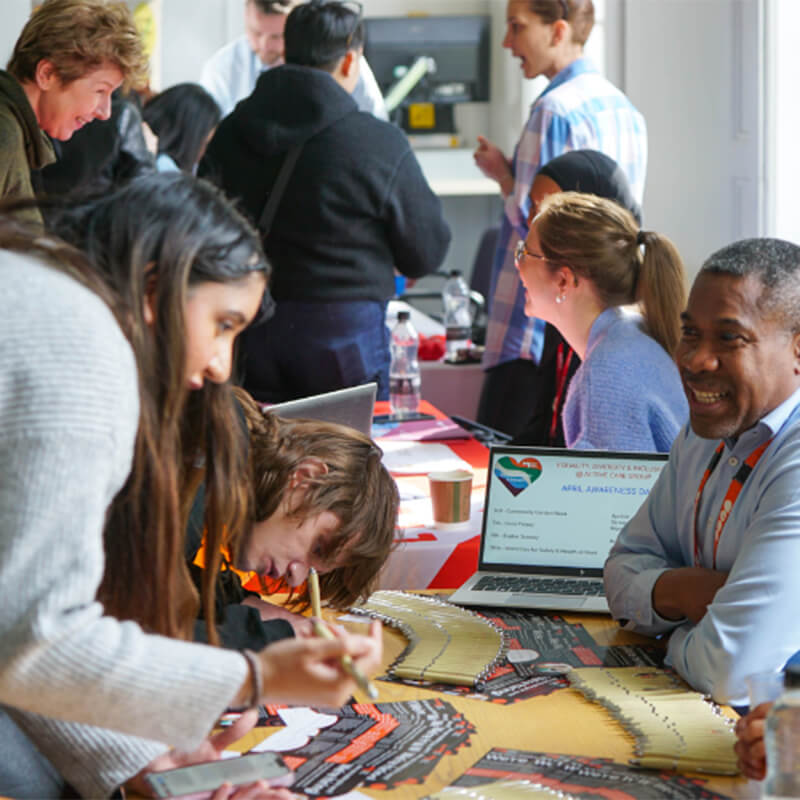
The Student Futures team is here to support you throughout your time at Roehampton and beyond.
They offer services tailored to your needs, helping you take confident steps towards your future.
You’ll have access to a wide range of career workshops and events, where you can engage with employers and develop the skills you need to succeed in the workplace.
These opportunities will help you build your CV, prepare for interviews, and connect with successful Roehampton graduates who are thriving in their careers. You’ll also be able to engage with our partners across London and beyond.
Wherever you want to go in the future, you'll be preparing for the world of work from your very first day.
Exciting Highlights from the BA History Programme
Here’s just a glimpse of the incredible opportunities waiting for you:
First year students: Our first-year History students took their studies beyond the classroom with a visit to the Wiener Holocaust Library in central London, the world’s oldest archive dedicated to the Holocaust.
After a guided tour of the collections and an introduction to the Refugee Map digital resource, they curated their own temporary exhibition, The Fragility of Freedom.
The display explored the disrupted lives of Jewish communities in 1930s Europe and was showcased in Roehampton’s University Library to mark Holocaust Memorial Day.
Second year students: Second-year students have been actively engaging with professionals. This term, they connected with leaders from:
-
Frontline, England’s largest social work charity and top graduate employer
-
Curators and outreach experts from the Museums Association and National Portrait Gallery
-
Author and creative coach Rachel Knightley
-
Former Roehampton student Avraham Goodman, now a Senior Policy Officer for the UK Government


Third year students: Third-year students visited the powerful Holocaust Galleries at the Imperial War Museum London with Dr Caroline Sharples. They examined how history is communicated through exhibition design, storytelling, and artefacts. To take this experience further, students are looking forward to a special Q&A with Dr James Bulgin, Head of Public History at the IWM, to learn how this landmark exhibition was brought to life.
Holocaust Memorial Day: This year, we were honoured to welcome Holocaust survivor Anne Wolfe-Skinner to campus. She shared her deeply moving life story with students and staff - a profoundly human and emotional reminder of why the study of history matters.
Learning and assessment
At Roehampton, you’ll be part of a vibrant academic community where your ideas matter and your development as a historian is supported every step of the way.
From inspiring lectures and hands-on seminars to thought-provoking field trips and collaborative projects, your learning will be active, engaging, and tailored to prepare you for the real world. With no exams and 100% coursework, you’ll be assessed in creative and practical ways, developing skills that employers value and that you can take into a wide range of careers.


How you’ll learn:
At Roehampton, your learning experience is designed to be interactive, supportive, and deeply rewarding. You won’t just sit and listen - you’ll get involved, debate, collaborate, and grow as a historian.
You’ll:
- Take part in dynamic workshops built around discussion, debate and interactive challenges
- Investigate the past using powerful primary sources - from archival documents and oral testimony to images, objects and digital collections
- Experiment with digital tools and creative methods used by historians today
- Design and create your own public history project, such as a podcast, exhibition or heritage trail
- Explore London’s world-class historical resources through inspiring field trips
- Work alongside heritage professionals, museum practitioners and other external experts.
Each year builds your confidence and independence - from mastering the basics in your first year to shaping your own research questions and projects by your final year - all within a supportive, close-knit learning community.
How you’ll be assessed:
Forget exams. Your degree is assessed entirely through exciting, real-world coursework designed to showcase what you can really do.
You’ll be assessed through:
- Essays that sharpen your critical thinking and argument-building skills
- Presentations that boost your confidence and communication skills
- Creative and public-facing work such as blogs, posters, media reviews or digital outputs
- Consultancy-style reports responding to real challenges in heritage, culture and education
- A final-year research project that brings everything together.
Assessment builds step by step, with plenty of guidance, examples and constructive feedback along the way. Flexible assessment options ensure you can play to your strengths, and graduate with a standout portfolio of work you’ll be proud to show employers.
Course staff
Dr Andrew Wareham
Dr Andrew Wareham is Reader in Economic and Social History, specialising in the medieval period and the late 17th century. He is interested in comparative approaches to History, and is currently researching the relationship between taxation, hierarchy, and community in England. He teaches modules in medieval and early modern history, with a focus on Europe and Asia.

Dr Caroline Sharples
Dr Caroline Sharples is Senior Lecturer in Modern European History. She is especially interested in history and memory, and her research specialism concerns the postwar legacy of National Socialism. She is currently writing a cultural history of the death of Adolf Hitler. Caroline teaches modules on historiography, dictatorship and representations of the Holocaust.

Candace Scarborough
Candace Scarborough is a historian and movement artist. She is interested in the histories of marginalised groups in the late medieval and early Tudor period, specialising in African presence in England and women's careers at the Tudor court. Her research explores collaborations between history, performance, and heritage.

Prof. Fiona McHardy
Professor Fiona McHardy is an expert in the cultural history of violence in antiquity. She is currently writing a book on Gendered Violence in Ancient Greece, covering such topics as infanticide, sexual assault, and domestic violence. Fiona teaches modules on ancient Greek history and literature.

Dr Helen Esfandiary
Dr Helen Esfandiary is a cultural historian specialising in the body, medicine, disease, gender in the early modern and Georgian periods, with a particular interest in the perspectives of mothers and medical practitioners on children and adolescents.

Dr Katerina Volioti
Dr. Katerina Volioti, Lecturer in History, teaches modules on Art History, museums, and digital humanities. Katerina's research draws from deep social theory and makes connections between ancient and modern periods.

Professor Ted Vallance
Professor Ted Vallance works on the political history of seventeenth-century England. He is currently writing a new history of the trial and execution of Charles I. Professor Vallance teaches our third-year module 'Radicalism in the English Revolution.'

Dr Dustin Frazer Wood
His research focuses on the ways European writers and artists have discovered, imagined and remade classical and medieval literature, history and material culture over the past 600 years.

Mark Wilson
Mark Wilson specialises in political thought, parliament and propaganda in mid-Elizabethan England. His other interests are late Medieval and Early Modern Political thought, political culture from 1400-1700, Shakespeare’s England and the History of London.

Bethan Davies
Her research focuses on Renaissance literature, culture and history. She is interested in the connections between colonial commodities and constructions of gender in early modern England, specifically the global and domestic intersections between sugar and femininity in the Renaissance period.

Open days
Get a real taste of our campus, community and what it’s like to study at Roehampton
Entry requirements
Entry tariff
2027/28 entry: 112–128 UCAS points (or equivalent)
2027/28 entry: Foundation Year: 64–80 UCAS points (or equivalent)
Looking to work out your UCAS points or find out about our entry requirements? Find out more.
When we consider applications to study with us, we form a complete view of your achievements to date, and future potential, and can offer flexibility in entry requirements. Find out more about our Contextual Offer scheme.
General entry requirements
Entry tariff
2027/28 entry: 112–128 UCAS points (or equivalent)
International Foundation Pathway:
64 UCAS (or equivalent)
IELTS: 5.5
Looking to work out your UCAS points or find out about our entry requirements? Find out more.
When we consider applications to study with us, we form a complete view of your achievements to date, and future potential, and can offer flexibility in entry requirements. Find out more about our Contextual Offer scheme.
General entry requirements
Apply now
Applying to Roehampton is straightforward, and we're here to guide you through every step and answer any questions you might have.
If you currently live in the UK or Ireland, you can apply directly through UCAS. Check out our UCAS application guide for all the information you need.
If you live in the UK and already have all your exam results, you can apply to us directly.
If you’re an international student, you can apply to us directly or add Roehampton as a choice on your UCAS application. Check out our guidance for international students for more information.
If you have any questions or need some support, reach out to us.
Fees and funding
UK students
Tuition fees
| Entry date | Undergraduate Year 1 | Undergraduate Foundation Year |
|---|---|---|
| September 2027 | £TBC | £TBC |
Prices shown are for the first year of your degree.
Funding your studies
We also provide other ways to support the cost of living, including on-campus car parking, hardship support and some of the most affordable student accommodation and catering in London.
International students
Tuition fees
| Entry date | Undergraduate Year 1 | Undergraduate Foundation Year | International Foundation Pathway |
|---|---|---|---|
| September 2026 | £17,628 | £17,628 | £17,628 |
| January 2027 | – | – | £17,628 |
Prices shown are for the first year of your degree.
Funding your studies
We also provide other ways to support the cost of living, including on-campus car parking, hardship support and some of the most affordable student accommodation and catering in London.

Need help or advice before applying?
Arts, Humanities and Social Sciences
Integrating the creative dynamism of arts and digital industries with the deep-rooted traditions of humanities and social sciences.