
Entry tariff:
2027/28 entry: 48–64 UCAS points (or equivalent)
UCAS code:
To apply for Roehampton campus: NA99
To apply for Croydon University Centre, on your UCAS application select campus code 'C' when adding Roehampton (R48) and FdSc Nursing Associate.
Start date(s):
September 2027
Be part of the next generation of nurses delivering high-quality, evidence-based care in community settings and hospitals, and help people to live healthy lives. You can choose to study this course at our main Roehampton campus (March entry) or Croydon University Centre (September entry).
Did you know
In the 2023 NSS results, Roehampton’s Nursing degrees received outstanding results, ranking 1st in London, and 1st and 3rd respectively in the sector for Teaching.
The programme is accredited by the Nursing Midwifery Council (NMC).
Module details: In this module, you will begin developing your nursing practice through a combination of real-world placements and simulation-based education. This integrated approach supports the development of knowledge, skills, and professional behaviours required for safe, compassionate, and evidence-based person-centred care in line with NMC standards. Preparation includes clinical skills training and immersive simulation in the Clinical Simulation Centre, allowing you to practice safely before placement. You will engage with diverse simulation modalities, reflect on practice, and apply professional standards. Supernumerary placements across hospital, community, primary care, and social care settings will consolidate learning and enhance employability.
Module details: In this module, you will build the foundations needed to begin your journey as a Nursing Associate while transitioning into Higher Education. You will develop academic skills, including writing, literature searching, referencing, and digital literacy, enabling confident use of technologies such as generative AI. Core nursing theory, assessment tools, the nursing process, person-centred care, adverse childhood experiences, and trauma-informed care will support your growth as a safe, reflective, and accountable professional. Through case studies, reflective exercises, seminars, workshops, and digital learning, you will develop critical thinking, compassion, and integrity, preparing you for both academic success and future practice.
The aim of this interprofessional module is to introduce you to the key concepts and core foundations for the scientific study of life. A strong interprofessional ethos is built by bringing you and other students together and creating the opportunity to interact with and learn alongside students from a breadth of professional programmes. Subsequent modules will build on and integrate the strong foundations gained through this module to support the development of required profession specific knowledge and skills. You will develop a solid understanding of the structure and function of living organisms through the study of anatomy and physiological systems relevant to your programme of study. You will explore core physiological principles across the lifespan and, where appropriate, examine deviations from normal function, including aspects of pathophysiology.
How You'll Learn: You'll learn through practical sessions and workshops, lectures, online asynchronous tasks, and tutorials.
Module details: In this module, you will explore the principles that underpin public health, health promotion, and illness prevention, focusing on how nurses help improve population wellbeing. You will examine social determinants, sustainable approaches to care, and the use of evidence and digital tools to enhance safety and quality. Learning activities will include lectures, seminars, discussions, case studies, and community focused tasks that deepen your understanding of health inequalities and prevention strategies. Through a written assignment centred on a health promotion campaign, you will apply theory to practice and build the knowledge and confidence needed to contribute to equitable, effective care in diverse settings.
These are the current planned modules on this course and may be subject to change.
Please note that these modules are subject to validation by the Nursing and Midwifery Council (NMC).
Module details: In this module, you will explore the foundations of integrated care and collaborative working across health and social care systems, considering the complexity of care pathways and the challenges faced by patients and carers. You will engage with authentic case studies and the perspectives of service users and carers to contextualise learning for real-world application. Key leadership theories will be examined, and you will reflect on your own leadership style to enhance team performance and promote compassionate, effective care. Assessments include analysing a patient pathway through an infographic and reflecting on your leadership skills and future development.
Module details: In this module, you will develop the skills to critically evaluate clinical research and guidelines, applying evidence-based practice to improve patient safety and care delivery. You will explore opportunities for continuous quality improvement and foster a culture of shared learning and reflective practice. Teaching will support your ability to locate, assess, and apply research and policy guidance, including the use of search engines, websites, and AI tools. Groupwork and presentations will help consolidate learning. Assessments include a review of a selected guideline or research article and the creation of a poster and presentation focused on quality improvement initiatives.
Module details: In this module, you will develop the skills, knowledge, and professional behaviours required to deliver safe, compassionate, and evidence-based person-centred care in line with NMC standards. Preparation includes clinical skills teaching and simulation in the Clinical Simulation Centre, allowing you to integrate theory with practice and gain confidence before placement. You will engage with a variety of simulation modalities, including immersive and virtual reality experiences and Forum Theatre with service users, followed by debriefs to support reflective learning and application of professional standards. Supernumerary clinical placements across hospital, community, primary care, and social care settings will consolidate learning and enhance employability.
Module details: In this module, you will explore the foundations of integrated care and collaborative working across health and social care systems, considering the complexity of care pathways and the challenges faced by patients and carers. You will engage with authentic case studies and the perspectives of service users and carers to contextualise learning for real-world application. Key leadership theories will be examined, and you will reflect on your own leadership style to enhance team performance and promote compassionate, effective care. Assessments include analysing a patient pathway through an infographic and reflecting on your leadership skills and future development.
These are the current planned modules on this course and may be subject to change.
Please note that these modules are subject to validation by the Nursing and Midwifery Council (NMC).

Skills
Build the solid foundations for your future career in healthcare.
Working with a dedicated team of experienced clinicians and academics, you’ll gain and in-depth understanding of:
- providing support to registered nurses to deliver evidence-based, safe and effective care
- providing care for people of all ages from diverse backgrounds who have mental, physical, cognitive and behavioral care needs.
You will learn how to deliver care in a wide variety of settings, including clients’ own home, the community or in the hospital.
Learning
Enjoy hands-on learning in clinical settings
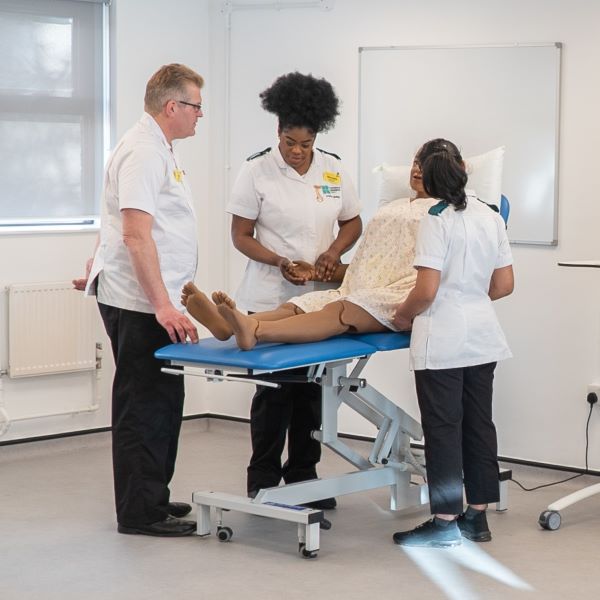
This course blends theory with hands-on practice in our classrooms and state-of-the-art Clinical Simulation Centres (CSC).
The programme will enable you to gain a comprehensive understanding of nursing today, including:
- Its role within 21st century health and care services
- The shift towards integrated care in the community as part of the NHS Long Term Plan
- The need for evidence-based practice for patient safety
- The importance of developing professional relationships with the people you care for and work with

Under the guidance of sector experts and academics, you’ll participate in:
- Lectures
- Seminars
- Group work
- Online learning
- Reflective practical exercises
You’ll also spend a significant amount of time in our Clinical Simulation Centres (CSC), where you’ll practice skills safely with:
- Other students
- Service users
- Carers
- Role players
- Hi-tech patient simulators
You’ll go on to refine your techniques through a series of real-world placements – learning how to provide exceptional care in a wide range of clinical settings.
Assessment
Hone your clinical skills and academic theory through practical and academic assessments.
During your time with us, you’ll undertake a range of academic evaluations and practice-based assessments. This includes:
- Reflective and case study-based assignments
- Exams
- Presentations
- Safety and quality enhancement projects
Your clinical skills will be evaluated through simulation-based assessments in our Clinical Simulation Centres (CSC).
Your performance and progress will also be measured on placements in various healthcare settings by both clinical and academic staff.
Careers
Help shape the future of healthcare and make a meaningful impact on the lives of people.
We pride ourselves on training healthcare staff who are highly sought after by employers. On completion of the FdSc you will be eligible to register with the Nursing and Midwifery Council as a Registered Nursing Associate (subject to approval). In addition, the FdSc can also be considered a stepping stone to becoming a registered nurse.

Open days
Get a real taste of our campus, community and what it’s like to study at Roehampton
Entry requirements
Entry tariff
2027/28 entry: 48–64 UCAS points (or equivalent)
Looking to work out your UCAS points or find out about our entry requirements? Find out more.
When we consider applications to study with us, we form a complete view of your achievements to date, and future potential, and can offer flexibility in entry requirements. Find out more about our Contextual Offer scheme.
Specific entry requirements
- GCSE English Language and Mathematics Grades C or 4 minimum or equivalent
- English and Maths: students must have GCSE in English and mathematics minimum grade C or above or Level 2 equivalency in literacy and numeracy.
- Have the capability to develop literacy and numeracy skills required to meet the programme outcomes.
- Have the capability to develop digital and technological literacy to meet the programme outcomes.
- Ability to meet NMC standards of good health and character, including:
- Satisfactory DBS disclosure and registration
- Occupational Health clearance
General entry requirements
Entry tariff
2027/28 entry: 48–64 UCAS points (or equivalent)
Looking to work out your UCAS points or find out about our entry requirements? Find out more.
When we consider applications to study with us, we form a complete view of your achievements to date, and future potential, and can offer flexibility in entry requirements. Find out more about our Contextual Offer scheme.
Specific entry requirements
- GCSE English Language and Mathematics Grades C or 4 minimum or equivalent
- English and Maths: students must have GCSE in English and mathematics minimum grade C or above or Level 2 equivalency in literacy and numeracy.
- Have the capability to develop literacy and numeracy skills required to meet the programme outcomes.
- Have the capability to develop digital and technological literacy to meet the programme outcomes.
- Ability to meet NMC standards of good health and character, including:
- Satisfactory DBS disclosure and registration
- Occupational Health clearance
General entry requirements
Apply now
Applying to Roehampton is straightforward, and we're here to guide you through every step and answer any questions you might have.
If you currently live in the UK or Ireland, you can apply directly through UCAS. Check out our UCAS application guide for all the information you need.
If you live in the UK and already have all your exam results, you can apply to us directly.
If you’re an international student, you can apply to us directly or add Roehampton as a choice on your UCAS application. Check out our guidance for international students for more information.
If you have any questions or need some support, reach out to us.
Fees and funding
UK students
Tuition fees
| Entry date | Undergraduate Year 1 |
|---|---|
| September 2027 | TBC |
Prices shown are for the first year of your degree.
Funding your studies
We also provide other ways to support the cost of living, including on-campus car parking, hardship support and some of the most affordable student accommodation and catering in London.
International students
Tuition fees
| Entry date | Undergraduate Year 1 |
|---|---|
| September 2027 | TBC |
Prices shown are for the first year of your degree.
Funding your studies
We also provide other ways to support the cost of living, including on-campus car parking, hardship support and some of the most affordable student accommodation and catering in London.

Need help or advice before applying?
Life and Health Sciences
Join our diverse Life and Health Sciences community, whose leading academics are dedicated to understanding and improving the living world through ground-breaking advances in scientific research.


