Our Commitment
Sustainability is embedded into our academic vision through the Supporting Achievement, Innovation and Learning (SAIL) framework, one of the five pillars underpinning curriculum development at Roehampton. Sustainability must now be embedded, taught and assessed at programme level as part of our curriculum design. This approach was a theme at the 2-day academic summit in January 2025 and a keynote topic for the June 2025 Academic Summit, with academic development led by the Learning and Teaching Enhancement Unit (LTEU). The approach is also part of the University of Roehampton's early career academic training programme.
Earth in Crisis: Interdisciplinary Approaches

Offered as an optional module across several programmes, Earth in Crisis: Interdisciplinary Approaches gives students the opportunity to explore environmental challenges from multiple academic perspectives. By drawing on insights from science, law, economics, philosophy and literature, the module fosters a deep understanding of the interconnected nature of today's global ecological crises.
With a focus on key issues such as biodiversity loss, climate change, and water security, students gain critical awareness of the complexity of sustainability problems – and the diverse tools and strategies needed to address them. The module not only strengthens subject knowledge, but also equips students with complex, transferable skills applicable far beyond the classroom.
This was the first truly interdisciplinary module developed at the University, designed to reflect the multifaceted nature of sustainability itself. As such, it plays a central role in our efforts to embed sustainability across the curriculum.
At our recent University Research Festival, Dr Gabor Sarlos presented Embedding Sustainability into Business Education: An Interdisciplinary Approach, using Earth in Crisis as a case study. His research highlights the need for holistic, cross-disciplinary education to prepare students for the challenges of a rapidly changing world. As Dr Sarlos notes, "sustainability challenges are inherently complex and require responses that transcend traditional academic boundaries."
"Earth in Crisis demonstrates how interdisciplinary teaching can help students develop the knowledge and mindset needed to tackle sustainability issues with both critical thinking and creativity."
– Dr Gabor Sarlos, Research Festival 2025
Work on Wednesdays Workshops
In mid-October 2026, the Faculty of Business and Law launched WoW!, a 5 weeks Work on Wednesday workshop series for undergraduate business and law students. Each Wednesday, two timetabled sessions addressed the topic of employability and career build in an engaging and interactive format. The most important aim was to expose students to industry inspired information and situations, consequently creating a safe space to practice and learn. With the combined resources of external speakers, Southlands College and own academic staff, and with an average attendance of 80 students, topics included developing one’s own personal brand, practicing the use of AI in developing a robust employee profile, identification of ‘”hidden’ job opportunities, mastering active workplace communication and identification of essential sustainability skills.
On the 19 November 2026 two sessions had sustainability in the focus. First, Professor Philiph Pryce focused on how automation and sustainability targets are reshaping employer expectations. Professor Pryce outlined and practiced with students adapting tech focus, sustainability and employability thinking into their CV and preparation for jobs. He shared his insights about how to best connect module lists to skills and competences, and then skills to industry demands. He shared examples on how AI savviness and sustainability knowledge have become the two most sought after competences by employers.
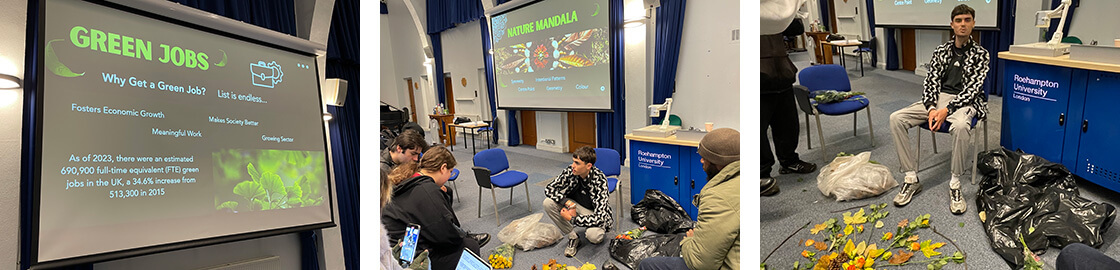
In the second session, our very own Roehampton alumni, Jonathan Nobrega focused on career building through engaging in sustainability. He highlighted how rapidly the demand increases for green jobs/skills across all types of organisations. The session helped students understand how to critically build green credentials for specific products and for themselves, and self-assess themselves against the 13 essential green knowledge and skill areas. He also helped students learn and experience nature connection, by linking it to concepts of ‘nature having an intrinsic value’ and ‘nature as a stakeholder’. As part of the session, students made a nearby walk and returned with collected elements of nature: leaves, grass cut, branches and turned these into a nature mandala. The discussion also covered interpretations of various essential conceptual frameworks, such as ESG, Triple Bottom Line and green washing.
Academics and students across Roehampton contribute to sustainability-focused research and initiatives. Their work helps drive progress on environmental and social challenges through innovative, interdisciplinary approaches:
- The Roehampton Climate Network connects researchers, staff and students working on climate and sustainability challenges. Learn more: Roehampton Climate Network.
- The Connected Waters Doctoral Training Programme supports interdisciplinary water-focused research with sustainability at its core. Find out more: Connected Waters.
Explore the Sustainability and Responsible Management Research and Knowledge Exchange Centre within the Business School, directed by Professor Stephen Drinkwater
How to Run a Slow Eco-Workshop
Promoting Sustainability Through Mindful, Interdisciplinary Conversations
By Dth research student Bridget Steenkamp
As a postgraduate student with a strong interest in sustainability, Bridget has been developing slow, mindful eco-workshops that encourage students and staff to engage in meaningful interdisciplinary conversations. These workshops invite participants to reflect on how sustainability can be embedded both within their academic disciplines and in their everyday lives.
The workshops are designed to be easy to replicate and adapt, offering a flexible model that allows people of all ages and abilities to connect with their local outdoor spaces and with one another. Through simple crafts and open conversations, participants are given agency and a platform where their voices can be heard.
Each workshop is rooted in a connection to nature in the local ecosystem and includes a gentle critique of an unsustainable practice. Sustainability challenges are often complex, making them particularly well-suited to interdisciplinary exploration. These workshops intentionally scaffold sustainability conversations while also facilitating networking and collaboration that might not otherwise occur.
Workshops often centre on familiar elements of the local environment—such as an oak tree, nettle plants, or clay soil—things participants may walk past every day. An interactive display and accessible craft activities invite immediate engagement from passers-by. As hands become busy, people naturally slow down and relax, creating space for deeper, more meaningful conversations.
A growing body of academic research shows that making and crafting can support learning and wellbeing in multiple ways. Repetitive activities using familiar skills—such as crocheting, doodling, knitting, or using a fidget tool—can improve concentration while listening to lectures or podcasts. Learning a new craft, on the other hand, fosters focus and mindfulness, as it requires presence in the moment. During these activities, past worries and future anxieties are often set aside, supporting positive mental health outcomes.
The sense of camaraderie and community created through shared making is equally important. Many new ideas emerge when people try new things together and collaboratively explore solutions. Play, in particular, has been shown to unlock creativity and promote wellbeing. In a time when many people feel stressed by deadlines, isolated, and short of opportunities for meaningful conversation and play, these workshops offer a valuable counterbalance that supports both well-being and academic success.
Slow eco-workshops are intentionally designed as grassroots, bottom-up learning experiences. Participants are free to engage in ways that feel meaningful to them and to make connections to their own academic, personal, and professional contexts. Even when the same workshop template is used, each session unfolds differently.
Because the workshops are run as drop-in sessions, there is no pressure to attend for the full duration or to produce a finished product. They are deliberately non-prescriptive, creating a welcoming environment for idea-sharing, curiosity, and community cohesion. Importantly, the workshops permit those who may feel they “don’t have a voice” to engage in sustainability conversations. They create a level playing field where participants can ask questions, share uncertainties, and explore ideas together.
Each workshop has the SIG Sustainability Goals embedded within its design.
In addition, each of Bridget’s slow sustainable workshops can be adapted into smaller, student-led sessions. After attending a few workshops, students are supported to run their own mini-workshops. These experiences can act as a stepping stone toward giving presentations or creating academic posters, as the workshops include links to academic resources and generate visual and conceptual material that can be photographed, documented, and tailored to individual academic interests.
In mid-October 2026, the Faculty of Business and Law launched WoW!, a 5 weeks Work on Wednesday workshop series for undergraduate business and law students. Each Wednesday, two timetabled sessions addressed the topic of employability and career build in an engaging and interactive format. The most important aim was to expose students to industry inspired information and situations, consequently creating a safe space to practice and learn. With the combined resources of external speakers, Southlands College and own academic staff, and with an average attendance of 80 students, topics included developing one’s own personal brand, practicing the use of AI in developing a robust employee profile, identification of ‘”hidden’ job opportunities, mastering active workplace communication and identification of essential sustainability skills.
On the 19 November 2026 two sessions had sustainability in the focus. First, Professor Philiph Pryce focused on how automation and sustainability targets are reshaping employer expectations. Professor Pryce outlined and practiced with students adapting tech focus, sustainability and employability thinking into their CV and preparation for jobs. He shared his insights about how to best connect module lists to skills and competences, and then skills to industry demands. He shared examples on how AI savviness and sustainability knowledge have become the two most sought after competences by employers.
In the second session, our very own Roehampton alumni, Jonathan Nobrega focused on career building through engaging in sustainability. He highlighted how rapidly the demand increases for green jobs/skills across all types of organisations. The session helped students understand how to critically build green credentials for specific products and for themselves, and self-assess themselves against the 13 essential green knowledge and skill areas. He also helped students learn and experience nature connection, by linking it to concepts of ‘nature having an intrinsic value’ and ‘nature as a stakeholder’. As part of the session, students made a nearby walk and returned with collected elements of nature: leaves, grass cut, branches and turned these into a nature mandala. The discussion also covered interpretations of various essential conceptual frameworks, such as ESG, Triple Bottom Line and green washing.