
Duration:
1 year (full-time)
Number of credits:
120
Start date(s):
September 2026
September 2027
The PGCE Primary at the University of Roehampton is a well-established and highly respected route into primary teaching, designed for those who want to make a real difference in children’s lives from the very start of their education.
We are proud of our Ofsted 2026 ‘strong’ standard grade which has replaced our previous ‘outstanding’ judgement. Ofsted recognised the quality of our provision across all areas of the inspection toolkit.
This covers Inclusion; Curriculum; Teaching and Training; Achievement; Professional Behaviours, Personal Development and Well-being; and Leadership. Ofsted recognised, Trainees are rightly proud to begin their teaching career here. Trainees in both the primary and secondary phase receive an expertly taught curriculum and strong mentorship.
Froebelian principles, with their emphasis on childhood, play, creativity and holistic development, run through the programme and inform how we think about learning in the early years and beyond.
You will explore how children learn and develop from the Early Years Foundation Stage through Key Stage 2, with a strong focus on understanding brain development, wellbeing, inclusion and the foundations for lifelong learning. At the same time, the course reflects the realities of today’s primary classrooms. You will engage with issues such as equity, diversity and inclusion, digital literacy, sustainability and the safe and effective use of technology, ensuring you are well prepared for contemporary teaching.
You will be known as an individual, supported academically and professionally, and challenged to grow in confidence, skill and judgement. Strong partnerships with local schools underpin the programme, offering carefully structured placements and high-quality mentoring that support your development week by week.
The PGCE Core route prides itself on the strong, pastoral support offered through your Personal Tutor who will support you at every step of the way across the programme
Enhancement pathways available
You will also benefit from 4 distinct weeks of intensive training and practice focusing on key elements of teaching. These include creating a positive classroom culture, systematic synthetic phonics, scaffolding learning and an employability enhancement route focus. These employability enhancement routes have been planned with school leaders to make you more employable in a competitive job market.
The enhancements are:
- PE employability enhancement route - benefit from additional expert training in PE from professional sports organisations and qualify as a Junior Active Leader.
- Mathematics employability enhancement route - enhanced inputs on delivering high-quality Maths teaching, including how to be a Maths subject leader.
- SEND employability enhancement route - specialist input on how to teach pupils with SEND in mainstream sc
Did you know?
Roehampton has a long-standing commitment to training educators that began in 1841, making it one of the longest-established centres for teacher education in the UK.
This long tradition continues today through an Ofsted-rated ‘strong’ standard across all areas of the Ofsted toolkit. Ofsted recognised the quality of our provision across all areas of the inspection toolkit, from curriculum and teaching to inclusion, achievement, wellbeing and leadership.
Modules
Core route, Apprenticeship Pathway, Lead Partner Pathway (full-time and part-time)
The Professional Studies module of the PGCE focuses on all aspects of your development as a teacher that are not subject-specific. The module is at the heart of the Primary PGCE course, supporting your development and understanding of all facets of learning and teaching including assessment, planning and reviewing the impact of strategies adopted. It will provide the scaffold for your learning across all other modules and in your school experience and will help you become an evidence-informed, reflective and resilient practitioner, well-equipped for your ECT induction.
The first part of this module focuses on building your understanding of how children learn by studying seminal theories of learning and the more recent neuroscientific developments that have provided insights into the complex process of learning. From this theoretical foundation, you will develop understanding of how teachers include in their own practice evidence-informed learning and teaching strategies so that you can develop a repertoire of skills and approaches that will support all children’s learning. Crucially, you will also consider important research which considers holistic approaches to promoting achievement and progress, taking into account children’s earliest developmental experiences. You will learn about, practise and refine key teaching practices such as planning and assessment to prepare you effectively for assessed school experiences.
Securing inclusive practice is a key strand throughout this module and learning includes considering how the needs of all children can be met to secure the best possible outcomes for each one. Groups of pupils vulnerable to underachievement will be looked at in greater depth – pupils with learning differences, SEND or who may be neurodiverse, pupils from Black and Global Majority (BGM) heritage, children working with English as an additional language, disadvantaged pupils – along with the evidence about how teachers can make the biggest difference to these children by adopting highly effective pedagogical strategies.
Throughout the module, you will be encouraged to think critically, in order to become a confident, autonomous professional. Your learning will be informed by the current Department for Education’s (2024) Initial Teacher Training and Early Career Framework (ITTECF) but the module extends beyond the ITTECF in enabling you to develop the attributes set out in Roehampton’s 4Rs: resilience, respectfulness, resourcefulness and the ability to reflect on what you have done.
The module will work in conjunction with the School Experience module to support your development as a teacher.
In the Core Curriculum module, you will focus on the development of subject knowledge and pedagogy in the Early Years Foundation Stage (EYFS, DfE, 2025) and national curriculum (DfE, 2013) core subjects and EYFS equivalents: English, mathematics and science. Your learning will link closely with the Professional Studies module and the pedagogical understanding contained therein.
The teaching and learning strategies adopted in this module aim to reflect, model and exemplify the range of approaches that you will encounter within primary teaching and learning and encourage you to become independent, autonomous learners. You will be encouraged to analyse and evaluate the teaching and learning approaches you encounter within partnership schools. Principles underlying practice will be explored in the light of theory and research. Through this approach, you will be encouraged to generate your own approaches to teaching and learning, informed through experience, critical reflection, discussion, research and reading.
The module, and the subjects within, will allow you to use key concepts to develop your professional competence, including planning appropriate learning objectives and adopting teaching and assessment strategies. The module will also encourage you to understand the value of the subject within the curriculum and to inspire you to become passionate teachers of English, mathematics and science.
Embedded within the module is exposure to, and opportunities to reflect on, high-quality practice through effective partnership with local schools including through intensive training and practice (ITaP) experiences, which will focus on systematic synthetic phonics (SSP) and the role of scaffolding in supporting learning.
The course is mapped against the Department for Education’s (2024) Initial Teacher Training Early Career Framework (ITTECF) drawing on literature from this document as well as other seminal research to provide a secure evidence base from which students can develop and evaluate their practice. The module extends beyond this in enabling student teachers to develop the attributes set out in Roehampton’s 4Rs: resilience, respectfulness, resourcefulness and the ability to reflect on their planning, teaching and children’s learning in the three core curriculum subjects.
This module will work in conjunction with the School Experience module to support your development as a teacher.
The Wider Curriculum module of the PGCE focuses on your development as a teacher of a broad, balanced and engaging curriculum that promotes the talents and interests of every child.
It will build your subject knowledge in preparation for classroom practice so that you can knowledgeably, confidently and enthusiastically teach lessons, and understand how the curriculum can be planned and assessed to support children’s learning in the early years foundation stage (EYFS) and key stages one and two. You will learn about the value of a broad and balanced curriculum to promote children’s understanding, curiosity and enthusiasm for learning so that every pupil can fulfil their potential.
As well as securing foundational subject knowledge and familiarity with the National Curriculum, there will be a focus on active and experience-based learning to help children make secure connections between new knowledge and their understanding of the world. It will encourage you to think about how to use active learning, objects, places and planned experiences to enrich children’s learning, to promote their curiosity and to recognise their contributions to life in school and the wider community.
You will also engage with authoritative literature that underpins each subject, in this way developing your academic confidence and skills. This will allow you analyse, and plan for, effective practice through supported observations of learning and teaching and develop skills in assessing pupils’ learning in these subjects.
You will cover subject knowledge in the wider curriculum subjects: art and design; computing; design and technology; foreign languages; geography; history; music; physical education; PSHE/RSHE; and religious education.
Throughout the module, you will be encouraged to think critically, in order to become a confident, autonomous professional. Your learning will be informed by the current Department for Education’s (2024) Initial Teacher Training and Early Career Framework (ITTECF) but the module extends beyond the ITTECF in enabling you to develop the attributes set out in Roehampton’s 4Rs: resilience, respectfulness, resourcefulness and the ability to reflect on what you have done.
This module is the school-based element of the PGCE course which will facilitate your professional development and progress towards meeting the Teachers Standards (DfE, 2021). You will develop your skills in the five core areas of practice – behaviour management, pedagogy, curriculum, assessment and professional behaviours – and apply, in practice, the knowledge, skills and behaviours that define great teachers and the high-quality learning they deliver for children. You will implement all you have learnt through your Professional Studies, Core and Wider Curriculum modules so that you become confident teachers ready for your early career induction. You will choose an age-phase preference for placements, focusing either on Early Years Foundation Stage and Key Stage 1, or Key Stage 1 and 2 for these school experiences.
You will have two, contrasting school experiences (varied by age phase and other school-related factors such as size and the percentages of disadvantaged pupils it serves) and across these placements build up from initially supporting the class teacher to latterly taking the lead in assessment, planning and choosing appropriate learning and teaching activities for children. You will ensure that practice is adapted to support the learning of every child, including those who might be vulnerable to underachievement. You will learn how to interact and engage fully in the life of the school, demonstrating the skills to contribute to children’s learning and development beyond those in your class. You will start to fulfil the wider responsibilities of teachers and learn new skills to help you manage workload and wellbeing when sustaining an 80% teaching timetable for an extended period of time. Throughout, you will be supported by expert mentors working in the school and from a Lead Mentor working with the programme team who will ensure that your placement provides the best opportunities for you to develop your practice. For students on a Lead Partner route or Apprentices, placements are arranged by the Lead Partner or apprentice-employing school.
In addition to the two placements, you will also secure foundational learning and teaching skills through four intensive training and practice (ITaP) weeks which will focus on behaviour, systematic synthetic phonics, scaffolding and the Employability Enhancement route.
Throughout the module, you will be encouraged to think critically, in order to become a confident, autonomous professional. Your learning will be informed by the current Department for Education’s (2024) Initial Teacher Training and Early Career Framework (ITTECF) but the module extends beyond the ITTECF in enabling you to develop the attributes set out in Roehampton’s 4Rs: resilience, respectfulness, resourcefulness and the ability to reflect on what you have done. In all these ways you will be effectively prepared for the process of applying for a teaching post and for your early career teacher (ECT) induction period.
These are the current planned modules on this course and may be subject to change.
Careers
Graduates of the PGCE Primary are highly sought after by schools in London and beyond.
Many secure teaching posts during or shortly after completing the course and progress confidently into their Early Career Teacher induction.
The programme prepares you not only to meet the Teachers’ Standards, but to enter the profession as a reflective, adaptable and committed teacher. You will develop the confidence to contribute to school life beyond your classroom, working collaboratively with colleagues, engaging with parents and carers, and supporting the wider curriculum.
Your training also provides a strong foundation for future progression, including subject leadership, pastoral roles, inclusion and SEND specialism, and further study at Master’s or doctoral level.
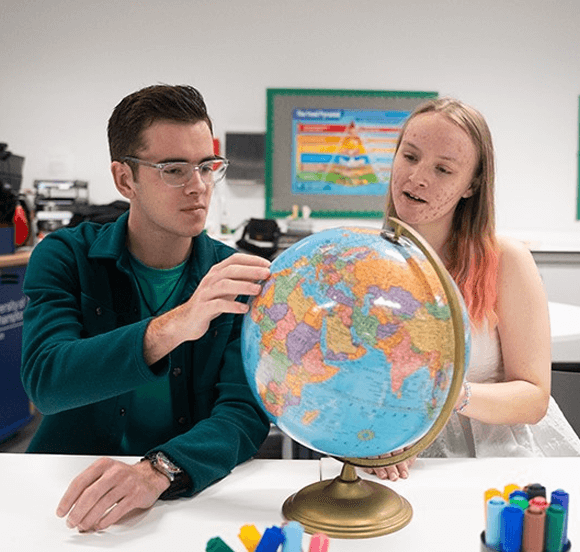
Our careers team is available to support you from the start of your studies until after you graduate. We will help you build your CV, prepare for interviews, and meet and learn from successful graduates working at the top of their careers.
The Student Futures team is here to support you throughout your time at Roehampton and beyond.
They offer services tailored to your needs, helping you take confident steps towards your future.
You’ll have access to a wide range of career workshops and events, where you can engage with employers and develop the skills you need to succeed in the workplace.
These opportunities will help you build your CV, prepare for interviews, and connect with successful Roehampton graduates who are thriving in their careers. You’ll also be able to engage with our partners across London and beyond.
Wherever you want to go in the future, you'll be preparing for the world of work from your very first day.
#1 in London for postgraduate students
WhatUni Student Choice Awards 2026
How you will learn
Learning on the PGCE Primary is shaped by the close relationship between university-based teaching and school experience.
What you explore in seminars is directly connected to what you practise in the classroom, allowing you to apply ideas, reflect on impact and refine your approach throughout the year.
You will learn through:
- Interactive seminars focused on subject knowledge, pedagogy and classroom practice
- Structured asynchronous learning that supports subject knowledge development and preparation
- Intensive training and practice periods focused on key teaching skills
- Placements in two contrasting school settings
- Regular mentoring from experienced class teachers and Roehampton Lead Mentors
- An allocated Personal Tutor who will support you across the programme
The course is carefully sequenced to support your development across the year, moving from foundation learning through to increasing independence and professional judgement. You will be supported to reflect on your practice, manage workload, and build resilience as you prepare for the demands of teaching.

Want to know what it's really like to study a PGCE at Roehampton? Check out these short videos to hear directly from our students and alumni:
Alumni Insight: Meet Alex Feldman, who studied PGCE Primary with us in 2008 and is now a Deputy Headteacher. He shares his journey and how Roehampton shaped his career.
👉 Watch on Instagram
Student Voices: Current PGCE Primary students Sophie and Eleanor talk about their experiences on the course, what they’ve learned, and why they chose Roehampton.
👉 Watch on Instagram
You will be required to complete an enhanced DBS check prior to starting the programme.

How you will be assessed
Assessment on the PGCE Primary is closely aligned to professional practice and progression towards Qualified Teacher Status.
Tasks are designed to reflect the real work of teachers, combining academic thinking with classroom application.
- Subject and pedagogical knowledge
- Planning, teaching and evaluation of learning
- Reflection on practice and pupil progress
- Understanding inclusion, SEND and adaptive teaching
- Professional communication and presentation skills
You will complete assessed work across three taught modules alongside a pass or fail school experience component. Regular formative feedback, assignment workshops and mentoring meetings support your progress, helping you understand expectations and build confidence in your academic and professional skills.
Assessment is designed to support learning, not just measure it. Feedback and feedforward are used throughout the year to help you improve, reflect and prepare for the next stage of your development as a teacher.
Open days and webinars
Get a real taste of our campus, community and what it’s like to study at Roehampton
Applying
How to apply
To apply for this course on DfE Find and Apply system, please click on the link below:
You can also access a lot of useful information about all aspects of training to be a techer on the Get into Teaching website.
The PGCE Primary programme covers the 3-11 age phase so you will be qualified to teach the Early Years Foundation Stage, Key Stage 1 and Key Stage 2. Your two assessed placements will be in contrasting age phases. PGCE Primary course code: X121.
We recommend that all candidates have some recent experience of being in a classroom and observing teaching and learning. You may be able to arrange this with schools in your local area or that you have a contact with. If you would like help finding a school to visit then please use the Government’s Get into Teaching website -https://getintoteaching.education.gov.uk/train-to-be-a-teacher/get-school-experience
Specific entry requirements
Please visit this page for full details of the entry requirements for PGCE Primary.
General entry requirements
How to apply
To apply for this course on DfE Find and Apply system, please click on the link below:
You can also access a lot of useful information about all aspects of training to be a techer on the Get into Teaching website.
The PGCE Primary programme covers the 3-11 age phase so you will be qualified to teach the Early Years Foundation Stage, Key Stage 1 and Key Stage 2. Your two assessed placements will be in contrasting age phases. PGCE Primary course code: X121.
We recommend that all candidates have some recent experience of being in a classroom and observing teaching and learning. You may be able to arrange this with schools in your local area or that you have a contact with. If you would like help finding a school to visit then please use the Government’s Get into Teaching website -https://getintoteaching.education.gov.uk/train-to-be-a-teacher/get-school-experience
Specific entry requirements
Please visit this page for full details of the entry requirements for PGCE Primary.
General entry requirements
Fees and funding
UK students
Tuition fees
| Entry date | PGCE |
|---|---|
| September 2026 | £9,790 |
Prices shown are for the first year of your degree.
Funding your studies
We also provide other ways to support the cost of living, including on-campus car parking, hardship support and some of the most affordable student accommodation and catering in London.
You will be required to complete an enhanced DBS check prior to starting the programme.
One re-take placement may be allowable (at no additional cost) across the length of your course. This is subject to a 're-start' and application process alongside a placement panel to check on suitability in relation to our current Assessment Policy.
Placement travel will incur some cost. When you may be entitled to have some of the cost of journeys between term-time accommodation and school placements reimbursed. Travel is via the cheapest mode of travel. Taxis, parking or congestion charges cannot be reimbursed. Contact us for further details: StudentTravelClaims@roehampton.ac.uk
International students
Tuition fees
| Entry date | PGCE |
|---|---|
| September 2026 | £18,250 |
Prices shown are for the first year of your degree.
Funding your studies
We also provide other ways to support the cost of living, including on-campus car parking, hardship support and some of the most affordable student accommodation and catering in London.

Need help or advice before applying?
Education
The School of Education is renowned for its high-quality teaching and research, and is one of the principal teacher training providers in the UK.


