Entry tariff:
112–128 UCAS points (or equivalent)
UCAS Code:
W520
Start date(s):
September 2026
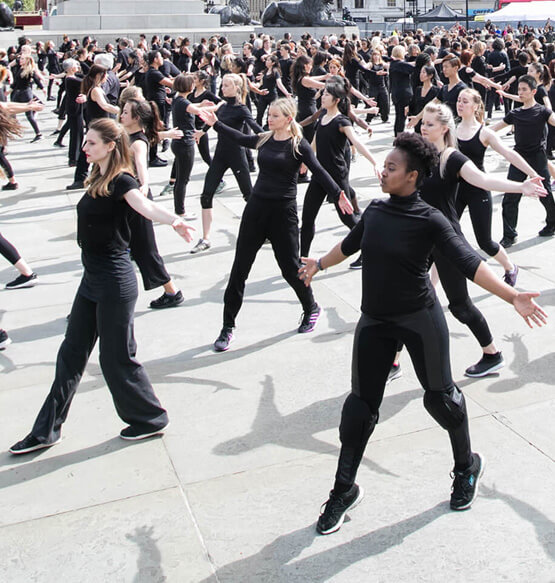
Bring together your passion for dance, performance and exercise science at Roehampton, and step into a degree that leads to exciting careers in dance, fitness, health and wellbeing.
With a strong focus on technique and performance, your dance classes will develop your creative potential, enhance your versatility and extend your physical capabilities. Alongside this, exercise science modules will deepen your understanding of anatomy, physiology and the biomechanics of movement, giving you the scientific insight to support and elevate your dancing.
Taught collaboratively by leading experts in Dance and Sport and Exercise Science, the course is aligned to professional standards set by the Chartered Institute for the Management of Sport and Physical Activity (CIMSPA), giving you the opportunity to gain fitness and Pilates teaching qualifications throughout the degree.
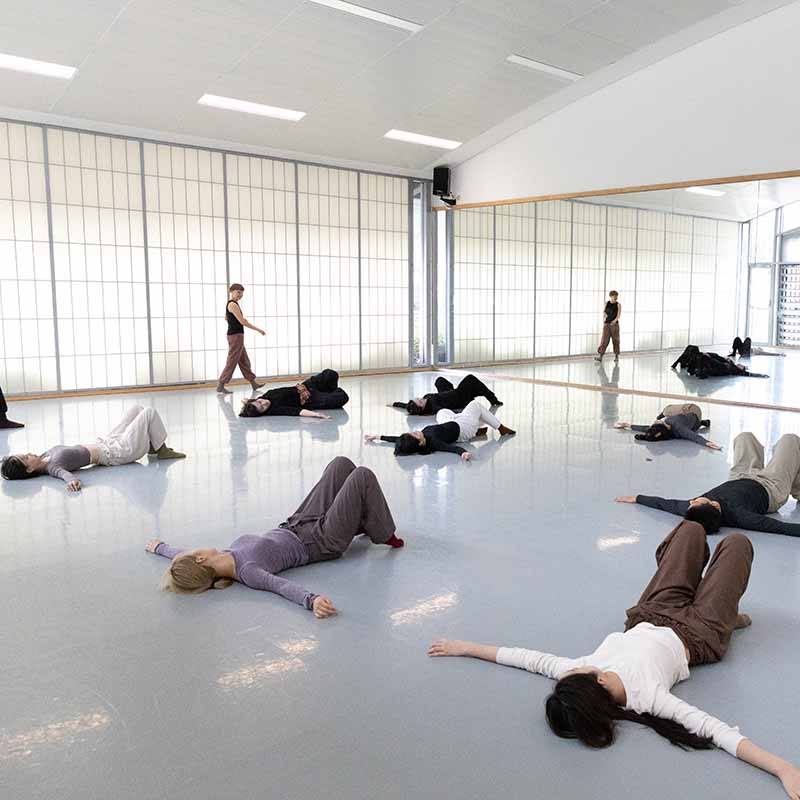
This unique combination of technical proficiency and evidence-based fitness education equips you with the knowledge and skills to build a successful career in dance performance, fitness, community practice, dance for health or dance education. Designed to prepare you for the workplace, the degree opens pathways to a range of exciting roles across the dance, fitness, health and wellbeing sectors.
Roehampton’s commitment to community engagement means you’ll also gain hands-on experience working with diverse groups, preparing you for a future where creativity meets care, health and human impact.
The aim of this interprofessional module is to introduce you to the key concepts and core foundations for the scientific study of life. A strong interprofessional ethos is built by bringing you and other students together and creating the opportunity to interact with and learn alongside students from a breadth of professional programmes. Subsequent modules will build on and integrate the strong foundations gained through this module to support the development of required profession specific knowledge and skills. You will develop a solid understanding of the structure and function of living organisms through the study of anatomy and physiological systems relevant to your programme of study. You will explore core physiological principles across the lifespan and, where appropriate, examine deviations from normal function, including aspects of pathophysiology.
Module overview:
This practice module introduces a foundation study of dance techniques and movement improvisation, using a range of studio classes and individual workshop tasks. You are encouraged to draw connections between codified dance techniques, somatic practices, and other contemporary and commercial dance styles and genres which reflect recent developments in dance practice. The improvisation strand develops understanding of movement initiation and development, the use of imagery, sensation and the key foundations of body-form, dynamics, space and time as well as making compositional decisions in real-time
The module guides you to explore and challenge your own movement tendencies and your assumptions about dance technique and improvisation, in order to find more efficiency, functionality and expressivity in your dancing, and to begin developing a broader dance vocabulary through your practice. Drawing on knowledge about the human body from Contemporary and Commercial Dance you will support this.
How you'll learn:
You'll learn through practical classes, workshops, laboratory sessions, peer review and tutorials.
In this module you will be introduced to the study of human biomechanics - the application of mechanical principles to understand of how people move. Why can some people jump higher than others? How can sports scientists 'see' the strengths and weaknesses of different movements? In this module you will learn how to analyse human movement using cutting edge technology to answer questions like these. The module will draw upon contemporary knowledge, research, and innovation as well as align with industry needs and demands (specifically relating to CASES requirements).
Module overview:
This practice-based module continues to work with the skills and techniques that begun in the Autumn term with Techniques and Improvisation and begins to explore testing these for performance settings focusing on functioning well and finding the expressive body.
You will have the opportunity to interrogate your technical knowledge of dancing and deepen your awareness of communicating movement. Focus will be on performative qualities alongside essential technical practice. Rehearsal and presentation of a tutor-led final performance will offer an introduction to professional theatre practices, such as studio rehearsals, technical and dress rehearsals, and performance to a live audience. Here you can demonstrate the performative skills acquired in your first year in a final performance.
How you'll learn:
You'll learn through four sessions per week, split between regular technique training and rehearsing a dance piece with your tutor.
These are the current planned modules on this course and may be subject to change.
Module overview:
This module offers intermediate training and allows you to advance your practical dance skills in the context of dance art seen and performed in 21st-century Britain, within broad multicultural, global and artistic contexts. You will advance your practical dance and improvisation skills developed in Year 1. Approaches will be drawn from a variety of dance styles and movement practices and may include codified dance techniques (such as ballet and contemporary techniques), improvisation, somatic movement practice, and other popular and commercial styles appropriate to recent developments in the sector, preparing you to become a versatile practitioner.
Emphasis will be on the development of movement skills, energy use, strength and control, while expanding interpretative skills and performance quality.
Understanding embodied knowledge and the principles of movement, and how to work with others through sharing embodied understandings, development of the soft skills that dance is known for and are transferable to other contexts, is at the core of this practice module.
There is a focus on the acquisition of self-reflective and problem-solving skills equipping you with focus, concentration and resilience to be able to expand your physical and mental potential and to develop your communicative skills individually and in groups. You will be expected to become self-reliant practitioners and to develop your personal professional practice including class preparation, methods of injury prevention, awareness of well-being and the ability to collaborate and contribute to a community of practice.
How you’ll learn:
You’ll learn through practical studio sessions, supported by 30 minutes of weekly asynchronous content with audio-visual resources to reinforce your practice.
Module overview:
This module introduces you to the diverse career paths open to dance professionals, and to skills and responsibilities in research, funding, collaborative work and promotional activities. It prepares you for successful careers in the dance or creative arts professions through exposure to practical examples, drawing on real industry experiences. The module also considers the social context in which professionals create, curate and respond to work, addressing for instance political parameters such as arts policy and politics and the relationship between art and society. It fosters your growth mindset and motivation to become an engaged professional who is aware of your position in the community and the functions of dance within political and social frameworks.
How you’ll learn:
You’ll learn through weekly seminars and experiential learning, plus 30 minutes of asynchronous support with audio-visual and written materials. You’ll take part in tutor-led sessions to explore dance professions and their contexts, and you'll be encouraged to actively engage through discussions and practical tasks.
This professionally focused module equips you with a detailed understanding of exercise physiology, health screening, clinical considerations, and performance training. It prepares you to assess, monitor, and design inclusive interventions for diverse populations, from elite athletes to individuals with conditions such as cardiovascular disease, diabetes, respiratory disorders, and musculoskeletal disorders. You will explore human performance science, the pathophysiology of non-communicable diseases (NCDs), and their relationship with physical activity, alongside performance enhancement techniques such as, periodisation, for both athletic and general populations.
Successful completion of this module will make you eligible for CIMSPA qualifications including gym instructor, personal trainer, and long-term condition management.
Module overview:
This module follows on from Techniques and Embodied Principles in order that you can continue to extend your practical dance skills into performance. Approaches will be drawn from various cultural backgrounds, including codified dance techniques, improvisation and other contemporary and commercial dance styles appropriate to recent developments in choreographic practice. The emphasis of the module is on the development of performance skills and the problems and possibilities of ‘being seen’ (Deborah Hay) considering the performer-audience relationship in a range of potential performance spaces, such as the theatre, sites-specific, digital and commercial contexts. There is a focus on professional practice including the preparation of material, rehearsal skills and daily practice to support the final project of the module. The value of concentration and resilience will be revealed as ongoing tools of practice, so that you can develop the confidence to perform and to communicate in a group. Students will form groups to work on publicity material to promote their performance, such as posters, programmes and social media platforms as well as tools for reflection and documentation.
Classes will be accompanied by music, acknowledging dance and its potential within an interdisciplinary context. Dancers will gain a developed understanding and confidence of working with music.
How you’ll learn:
You’ll learn through weekly practical classes and workshops. The practical classes will cover two dance styles, while the workshops will focus on developing a performance. You’ll also get 30 minutes of weekly asynchronous support with audio-visual materials to reinforce both practical and performance work.
These are the current planned modules on this course and may be subject to change.
Professional Experience Year
This course also offers the option of a Professional Experience Year. This programme combines dynamic career modules with flexible placement opportunities. After completing your first year of study, you'll then spend the next academic year completing your Professional Experience training as part of your degree. This will give you real career experience. This unique opportunity offers you distinct paths to build your expertise.
Find out more about our Professional Experience Year
This course also offers all students the option of a one-year paid work placement, to boost your employability even further. If you choose this route, you will take the placement following year two of your course, and then return to complete your degree.
Why take a placement?
A placement year is the perfect opportunity to gain valuable work experience, to build on the career skills we will teach you on this degree. The connections you make on the placement will improve your career prospects further, and equip you with the skills you need to secure graduate-level employment.
How we support you
The University's Placement and Work Experience Team are experts at helping you to secure a placement. They will work closely with you from the start, helping you research potential employers, discover placement opportunities, create and pitch your CV, and will coach you to perform well in interviews. We aren't able to guarantee a placement, but our sector-leading advisors will give you the best possible chance of securing one.
Find out more about how we'll support you
We understand that your plans might change once you start your programme. If you decide not to do a placement, you will have the option of completing the three year version of your programme.
Whatever your choice, you will have access to many opportunities for work experience through our Placement and Work Experience Team, and access to face-to-face and 24/7 online careers support.
Module overview:
This module provides a framework for you to explore your advanced movement potential using a variety of approaches drawn from a range of dance contemporary, commercial and somatic practices with consideration to global perspectives. The technical, performative, improvisational and interpretative challenges of dancing are scrutinised and the interplay between physical, imaginative, observation and analytical skills is interrogated and developed. The module articulates questions about how dancers experience movement quality in relation to space and time and how detailed embodiment of movement arises through testing (trial and error) and safe and effective practice. Alongside a personal practice, the module will propel you to advance your skills and engage with expressive and interpretative group tasks in relationship to music, sound accompaniment, or text and to find methods of working with awareness and sensitivity in relationships with other dancers. Acknowledging dance’s potential within an interdisciplinary, professional and commercial context, dancers will gain advanced confidence in working with music and understand principles of collaboration in art making.
The continuity of ‘training’ through regular classes prepares you for the physical and mental demands of the various roles within the profession, such as navigating a portfolio career, as a dance artist such as performer, choreographer, teacher or community artist, as well as in related professional areas, in health, education, fitness, well-being sectors, or in related roles in the creative industries, including fashion, social media, design, commercials and video games.
It also asks transferrable soft skills such as resilience, critical self-reflection, adaptability and flexibility as well as an awareness for selfcare and safeguarding a healthy practice.
How you’ll learn:
You’ll learn through weekly practical classes.
Module overview:
In this module you will work on a live brief of a tutor-led choreography commission to develop a dance performance project. Cross-pollinating the practical and contextual skills and knowledge acquired from previous modules The Dance Profession in Social Contexts, Choreography, Production and Aesthetics, and Advanced Dance Practices, you will envisage, organize and develop a performance with all its accompanying aspects from digital and/or live, site-specific content creation, rehearsal and production. Working in groups, you will apply methods of devising and collaboration, exploring strategies of shared authorship and co-creation. Performance is approached in relation to trends and industry practices and can be realized either as a live event in a traditional theatre setting or an installation or a site-specific performance, or a digital event with outcomes of mediated choreography, on screen and on other digital platforms. Attention will be given to aspects of access and inclusivity, considering diverse audiences and media.
Professional practice and performance will be reinforced through technique classes, increasingly establishing an independent working attitude enabling the transition into the field after graduation. You will identify roles, and plan, curate and organize all relevant activities, such as rehearsal schedules, curation of the sharing event, promotion and documentation including programme notes, curator statements, social media content production and publicity, digital images, video content and post-performance reflections. The module offers an opportunity to gather material to develop a personal performance portfolio including a showreel, visual identity design (web presentation), and other related material.
How you’ll learn:
You’ll learn through practical dance classes and hybrid classes each week in the Spring term. The practical sessions will build your dance skills, while the hybrid sessions will focus on creating a performance event based on a tutor-led brief. You’ll also get 30 minutes of weekly asynchronous support with audio-visual resources to help develop your digital portfolio.
Module overview:
The Dance Industry exposes you to the key aspects of the dance industry and its infrastructure – teaching, community dance, festivals, dance organisations, the freelance dance artist, researching. It will offer you a rounded picture of these aspects through giving an overview of the research on the topics and analysis of the real-life contexts and issues that currently challenge the dance and arts sectors. The module will propose several case studies from the dance industry for you to engage with through research, problem solving or creative imagining. The module is designed to provide tools to think widely and deeply about professional scenarios and to learn more about the dance infrastructure in the UK and internationally. The module content draws on first year module Contemporary and Commercial Dance and second year module Dance Professions in Social Contexts, and these modules should be seen as contributing to your understanding and knowledge in The Dance Industry.
You will be taught through tutor-led seminars and workshops to enable you to gain a critical understanding and deeper knowledge of the dance industry. You will be encouraged to take a pro-active engagement in sessions, contributing to discussion and practical tasks.
How you’ll learn:
You’ll learn through a mix of seminars and experiential learning. There will be an additional 30 minutes of asynchronous digital support per week. This will consists of audio-visual and written material.
More details on this module will be provided shortly.
These are the current planned modules on this course and may be subject to change.
This course offers a foundation year, which takes place at the beginning of your studies. Studying a foundation year will give you academic and practical experience, and a strong introduction to your subject, ensuring you succeed on your undergraduate degree.
Careers
Combining creative dance expertise with a strong scientific foundation in exercise and health, you’ll graduate ready to step into multiple career pathways.
As the course is aligned with CIMSPA professional standards (Gym Instructor; Personal Trainer; Working with People with Long-Term Conditions; Pilates Mat-Based Instructor; Exercise to Music), you’ll be ready to step straight into paid work while developing your artistic portfolio.
As a graduate of BA Dance and Fitness, you’ll be equipped for a wide range of roles across dance, fitness, health and the creative industries. Potential career paths include:
- Dance teacher, facilitator or movement instructor
- Mat-based Pilates instructor (CIMSPA-aligned)
- Fitness or group exercise instructor (CIMSPA-aligned)
- Fitness coach within dance-focused settings
- Conditioning instructor within dance companies
- Personal trainer (CIMSPA-aligned)
- Support roles in integrated dance–wellbeing–health practice or dance science
- Roles across the arts, events and creative industries that draw on your embodied expertise
You’ll gain the skills to teach, to lead, to design training programmes, and know how to maintain your own physical wellbeing in demanding performance settings. The combination of creative and scientific expertise will make you highly employable, resilient, and adaptable across sectors.
You can also progress into postgraduate study in areas including dance science, teacher training, sport and exercise sciences, sports therapy, physiotherapy, public health, community dance facilitation or research education and postgraduate degrees.

Learning and Assessment
How you'll learn
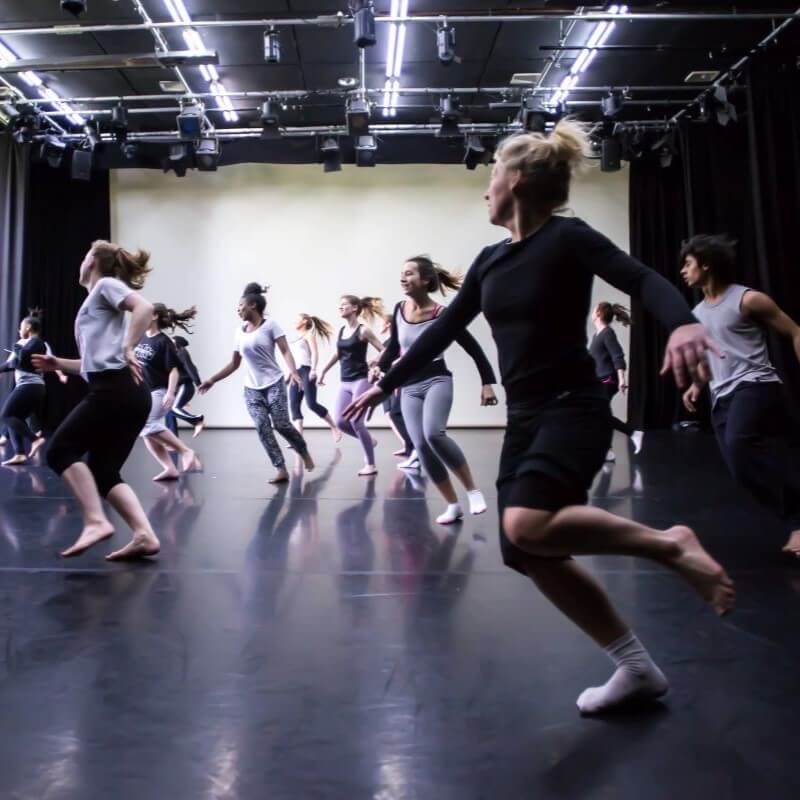
Your learning experience will be energetic, hands-on and deeply connected to the real world of dance and fitness.
You will learn through:
- Studio practice and technique development
- Dance labs where you create your work through improvisation or composition
- Applied science teaching, exploring anatomy, conditioning and safe practice
- Practical fitness instruction aligned with industry standards
- Community engagement, gaining experience with real clients and diverse groups
- Collaborative projects across disciplines
- Supportive academic mentoring that helps you thrive
Our strong entrepreneurial focus will help you build confidence, professionalism and career direction. You will graduate not only with artistic skill, but with a clear understanding of how to market yourself, manage your workload and succeed.


How you'll be assessed
Assessments mirror the types of work you’ll undertake in your professional life, ensuring you feel industry-ready from day one.
You’ll be assessed through:
- Solo and ensemble dance performances
- Dance projects and workshops
- Practical fitness instruction assessments
- Scientific and reflective written work
- Applied portfolios and case studies
- Dance science and conditioning tasks
- Industry-focused projects that mirror real practice
This balance of practical, creative and academic assessment ensures you develop confidence across every area of your professional skillset.
Open days
Get a real taste of our campus, community and what it’s like to study at Roehampton
Applying
Full-time UK undergraduate students apply through UCAS.
Entry tariff
112–128 UCAS points (or equivalent)
Looking to work out your UCAS points or find out about our entry requirements? Find out more.
When we consider applications to study with us, we form a complete view of your achievements to date, and future potential, and can offer flexibility in entry requirements. Find out more about our Contextual Offer scheme.
We welcome applicants with a wide range of qualifications, including BTECs, A-levels and T Levels.
General entry requirements
International undergraduate students apply through our direct application system.
Entry tariff
112–128 UCAS points (or equivalent)
Looking to work out your UCAS points or find out about our entry requirements? Find out more.
When we consider applications to study with us, we form a complete view of your achievements to date, and future potential, and can offer flexibility in entry requirements. Find out more about our Contextual Offer scheme.
General entry requirements
Fees and funding
UK students
Tuition fees
| Entry date | Undergraduate Year 1 | Undergraduate Foundation Year |
|---|---|---|
| September 2026 | £9,790 | £5,914 |
Prices shown are for the first year of your degree.
Funding your studies
We also provide other ways to support the cost of living, including on-campus car parking, hardship support and some of the most affordable student accommodation and catering in London.
International students
Tuition fees
| Entry date | Undergraduate Year 1 | Undergraduate Foundation Year | International Foundation Pathway |
|---|---|---|---|
| September 2026 | £17,628 | £17,628 | £17,628 |
Prices shown are for the first year of your degree.
Funding your studies
We also provide other ways to support the cost of living, including on-campus car parking, hardship support and some of the most affordable student accommodation and catering in London.

Need help or advice before applying?
Arts, Humanities and Social Sciences
Integrating the creative dynamism of arts and digital industries with the deep-rooted traditions of humanities and social sciences.