
Duration:
1 year (full-time)
Number of credits:
MSc: 180
Start date(s):
September 2027
Advance your career with our MSc Advanced Biomedical Science and develop the expertise to transform global healthcare practice and clinical research.
In an evolving Clinical Science landscape, our MSc Advanced Biomedical Science course equips you with the specialist knowledge and practical expertise/skills needed to thrive in clinical, research, and NHS-related industrial settings.
This programme blends cutting-edge laboratory training with research-led teaching, delivered by expert academics and practising biomedical scientists working within NHS pathology laboratories.

Did you know?
This course supports key UN Sustainable Development Goals, including Good Health and Wellbeing, Quality Education, and Industry Innovation, promoting real-world impact through NHS and IBMS partnerships and sustainable healthcare practice.
Explore real-world biomedical science through a multidisciplinary curriculum, gaining skills to advance diagnostics, tackle global health challenges, and drive innovation.
Laboratory-based research projects form a key part of the course, helping you develop the technical ability and ethical grounding required to conduct high-quality biomedical research. You'll also build strong data analysis and critical evaluation skills, giving you the tools to make a meaningful impact in your chosen field.
Whether you’re seeking to specialise, pursue a research career, or move into leadership roles, this programme will prepare you for a dynamic future in biomedical science.
This programme is accredited by the Institute of Biomedical Science (IBMS).
IBMS accreditation confirms that the programme meets its professional standards required for postgraduate education in Biomedical Science.
Recognition by the IBMS reflects both quality and industry relevance, supporting graduates in accessing a wide range of employment and professional development opportunities. It also demonstrates a continued commitment to advancing excellence in biomedical science.
Learn more about the Institute of Biomedical Science
Modules
Module details:
In this module, you'll build the practical laboratory expertise and professional skills needed in contemporary biomedical science. You'll explore advanced techniques including polymerase chain reaction (PCR), protein analysis, cell culture, flow cytometry, microscopy and histopathology, developing your understanding of how they are used in research and diagnostic settings.
Alongside laboratory work, you'll examine quality assurance, health and safety, professional ethics and the regulatory standards that underpin reliable biomedical practice. You'll also consider the role of point-of-care testing, laboratory automation and artificial intelligence in modern diagnostic services.
Through practical sessions, scientific communication activities and reflective work, you'll develop your confidence in interpreting results, solving problems and working with others. You'll document your learning in a laboratory portfolio and explore how technical expertise, leadership and continuing professional development support progression in biomedical science.
Module details:
In this module, you'll explore how infectious diseases develop, spread and affect the human body, and how the immune system responds to infection. You'll examine bacterial, viral, fungal and parasitic diseases, alongside the growing challenges of antimicrobial resistance and emerging infections.
Through lectures, practical activities and clinical case studies, you'll investigate host–pathogen interactions and learn how microbiological, molecular and immunological techniques support diagnosis and treatment. You'll also evaluate vaccination, immunotherapy, infection prevention and the role of public health in controlling disease.
You'll develop the skills to interpret laboratory findings, assess diagnostic tests and apply scientific evidence to clinical scenarios. This includes exploring point-of-care testing and digital tools used in infectious disease diagnosis, helping you build knowledge relevant to biomedical laboratories, healthcare and research.
Module details:
In this module, you'll discover how changes at a molecular and cellular level can lead to disease, and how this knowledge informs modern diagnosis and treatment. You'll explore gene expression, epigenetics, cell signalling and genome stability, examining their roles in conditions such as cancer, inherited disorders and neurodegenerative diseases.
Through clinical case studies, seminars and computer-based workshops, you'll investigate molecular diagnostics, histopathology and emerging approaches to personalised medicine. You'll also develop skills in bioinformatics and the analysis of complex biomedical data, including information generated by high-throughput technologies.
By interpreting research and clinical datasets, you'll learn to connect laboratory findings with disease mechanisms and healthcare decisions. The module will strengthen your analytical skills and your understanding of how molecular and cellular technologies are applied in biomedical science and research.
Module details:
In this module, you'll develop the research skills needed to investigate questions in biomedical science and evaluate scientific evidence with confidence. You'll explore research design, quantitative and qualitative methods, statistical analysis and ethical practice, learning how to choose approaches that suit different research questions.
Through lectures, computer-based activities and practical exercises, you'll work with data, use statistical software and practise presenting findings clearly. You'll also learn how to assess the quality of published research, manage data responsibly and consider risk and research governance.
Biomedical science-focused sessions will introduce applications such as bioinformatics, the use of artificial intelligence in genomics and the evaluation of point-of-care diagnostic tests. By the end of the module, you'll be better equipped to plan research, interpret results and communicate evidence, preparing you for your independent research project.
Module details:
In this module, you'll put your knowledge and research skills into practice through an individual project in biomedical science. You'll investigate a topic in depth, working with academic supervision to develop your research question, select appropriate methods and analyse your findings.
Your project may involve laboratory work, bioinformatics, other forms of data collection or an in-depth systematic review, depending on the project available. Throughout the process, you'll consider research ethics, health and safety, data handling and the scientific evidence relevant to your chosen topic.
You'll develop your ability to work independently, solve problems and communicate complex scientific information. To share your findings, you'll prepare a scientific report in the style of a journal article and present a conference-style poster, gaining experience of explaining and defending your research to a professional audience.
These modules are those we currently offer for 1 year (full-time) and may be subject to change.
Careers
This programme opens the door to a wide range of careers across clinical and research laboratories, industry, and beyond.
Graduates commonly pursue roles in medical research, NHS biomedical science, health charities, and biomedical-focused industries. Typical employers include the NHS, Health and Safety Executive (HSE), pharmaceutical industries, NHS Blood and Transplant (NHSBT), and UK Health Security Agency.
Career paths may include roles such as biotechnologist, clinical scientist (in areas like biochemistry, microbiology, haematology, or genomics), research scientist, and scientific writer or publisher.
You’ll benefit from expert career counselling, guest lectures from NHS pracademics and IBMS professionals, and opportunities to explore internships with industry partners.

The Student Futures team is here to support you throughout your time at Roehampton and beyond.
They offer services tailored to your needs, helping you take confident steps towards your future.
You’ll have access to a wide range of career workshops and events, where you can engage with employers and develop the skills you need to succeed in the workplace.
These opportunities will help you build your CV, prepare for interviews, and connect with successful Roehampton graduates who are thriving in their careers. You’ll also be able to engage with our partners across London and beyond.
Wherever you want to go in the future, you'll be preparing for the world of work from your very first day.
#1 in London for postgraduate students
WhatUni Student Choice Awards 2026
Learning & assessment
You’ll learn in a dynamic, inclusive environment that blends academic theory with practical, problem-based learning to prepare you for real-world biomedical science settings.
Our research-active lecturers bring cutting-edge expertise into the classroom, delivering high-quality teaching informed by current scientific developments. From face-to-face lectures and lab sessions to seminars, workshops, and case-based discussions, you’ll build specialist knowledge alongside essential transferable skills.
Laboratory work runs alongside theoretical learning, helping you develop the confidence to design and conduct experiments, a key skill for research and industry roles.
Throughout your studies, you’ll be supported by a collaborative teaching team and benefit from feedback mechanisms designed to support continuous improvement. We also work closely with employers, regulatory bodies, and students to ensure the curriculum reflects current needs and future opportunities.
How you’ll learn
This programme is designed to develop both academic knowledge and professional skills in a supportive, research-informed environment. You’ll apply what you learn to real-world scenarios, building practical competencies including effective and ethical use of AI, essential for a wide range of careers in biomedical science. Teaching is inclusive, global in perspective, and aligned with IBMS professional standards to ensure your learning remains relevant and career-focused.
Your learning experience will include:
- Case studies exploring global health issues, inequalities, and sustainability
- Projects examining international public health policies and clinical guidelines
- Professionally focused, employer-informed assignments
- Technology-enhanced learning with industry-relevant software
- Collaborative research with academic and industry partners
- Development of key intellectual and communication skills alongside technical expertise
How you'll be assessed
Assessment on this programme is designed to help you demonstrate your knowledge, skills, and progress in a clear, supportive way, training you to apply these skills in the industry. You'll be assessed through a combination of formative and summative methods that reflect your learning at each stage of the course, aligned to module and programme-level outcomes.
Your assessment experience will include:
- Formative assessments to monitor progress, build confidence, and provide feedback with feed-forward tasks ahead of formal submissions
- Summative assessments that contribute to your final grade, focused on understanding and applying scientific skills/writing, presentation, and critical analysis
- Clear guidance and insight into expectations for each assessment
- A continuous learning approach that links each module to future learning and skill development

Hands-on learning in state-of-the-art facilities
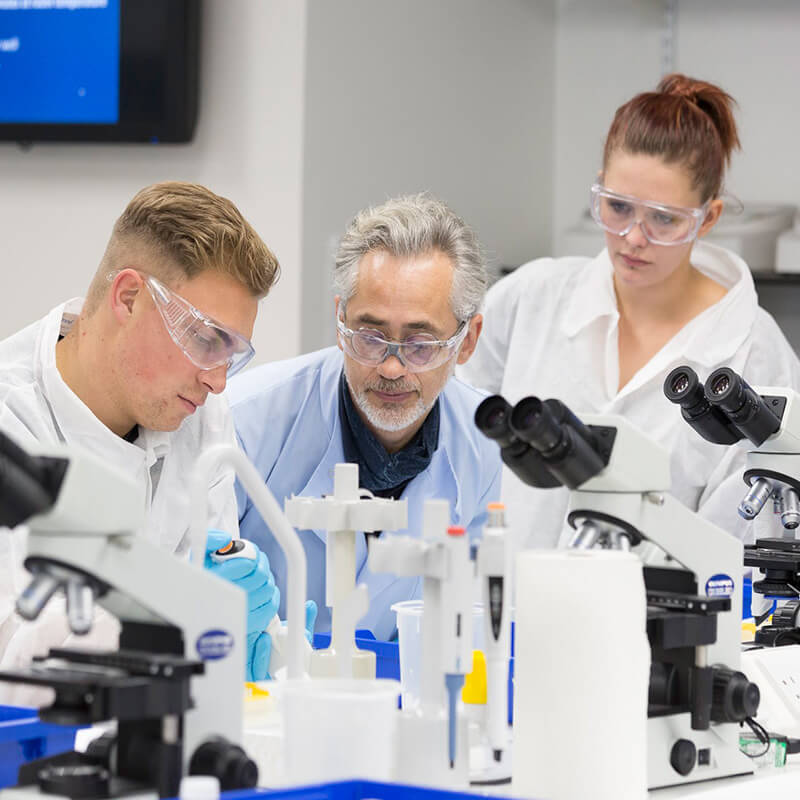
Our Biomedical Science facilities are designed to support practical learning and innovative research. Based at Whitelands College, a beautiful listed building overlooking Richmond Park, you will have access to a range of modern laboratories and specialist equipment used in biomedical research and diagnostics.
Students can gain hands-on experience with specialist resources including tissue culture facilities, gas chromatography systems, LC-MS, automatic cryostat with tissue staining, clinical analysers, PCR and qPCR machines, and fluorescence microscopes.
Open days
Get a real taste of our campus, community and what it’s like to study at Roehampton
Applying
Full-time UK postgraduate students apply through our direct application system.
Specific entry requirements
At least 2.2 honours UK degree or international equivalent (overall 60% or above in life sciences-related international UG degrees).
General entry requirements
International undergraduate students apply through our direct application system.
Specific entry requirements
At least 2.2 honours UK degree or international equivalent (overall 60% or above in life sciences-related international UG degrees).
IELTs of 7.0 with no score lower than 6.5
General entry requirements
Fees and funding
UK students
Tuition fees
| Entry date | MSc |
|---|---|
| September 2027 | £11,588 |
Prices shown are for the first year of your degree.
Funding your studies
We also provide other ways to support the cost of living, including on-campus car parking, hardship support and some of the most affordable student accommodation and catering in London.
International students
Tuition fees
| Entry date | MSc |
|---|---|
| September 2027 | £19,549 |
Prices shown are for the first year of your degree.
Funding your studies
We also provide other ways to support the cost of living, including on-campus car parking, hardship support and some of the most affordable student accommodation and catering in London.
