Duration:
1 year (full-time)
Number of credits:
180
Start date(s):
September 2027
This practical, industry-standard course helps you develop your creative voice while gaining technical and professional skills to succeed in today’s film and media industries.
Taught by industry-active academics, it uniquely focuses on real-world cultural impact, making work with a voice and preparing you to engage with public funding bodies and commissioners.
Why choose MA Filmmaking at Roehampton?
- Benefit from the personal touch, with small class sizes and industry specialists leading whole courses, not just dropping in for the occasional lecture.
- Learn sustainable filmmaking and climate storytelling through a BAFTA albert qualification.
- Take part in a wide range of networking events, job fairs, industry schemes and film festivals.
- Gain on-set work experience through opportunities we create on professional film and TV productions in London.
- Explore content creation, advertising and short form media supporting your journey.
- Develop a feature film via an industry-standard proposal, taking into account film development, finance, marketing and distribution.
- Learn Generative AI in filmmaking with Gemini, including character design, previsualisation, storyboarding and marketing design.
- Learn from staff like Programme Leader Josh Appignanesi, a working filmmaker with many commercials and seven feature films funded by organisations like BBC, BFI and Arts Council England. His films have been released theatrically in 30 countries, reaching key festivals like Berlinale, Tribeca, and Rotterdam with BIFA and BAFTA nominations.
- Enjoy industry standard camera, sound and studio environments in a London-based period campus.
Join An Accredited Course
The MA Filmmaking has Course Design Approval from the industry-leading International Moving Image Society (IMIS) which comes with annual membership to their many events, including industry screenings for your work like their Showcase.
And through our BAFTA albert Education Partnership, you’ll study sustainable filmmaking and storytelling and emerge with a recognised industry qualification.
You also get NAHEMI membership and participation in their various national student film competitions and screenings.


Modules
Drawing on global and historical examples and case studies, and with high-level industry guests, you explore key approaches to filmmaking, including the critical aims and conceptual traditions that have animated them. You’ll also look at the ways they have impacted on social and cultural realities for diverse groups.
Alongside this immersion in film and film culture, you’ll build an early-stage vision of a potential Graduation Project in fiction, documentary or content production, defining its key aims, influences and tradition.
Working in groups of around 2-5 depending on project type, you’ll develop and produce a documentary or hybrid film project with an open brief.
Project development includes conceptual teaching on transnational approaches and traditions, and is taught with an eye to cultural impact, whether a ‘message’, a novel storytelling angle, or a formal innovation. We’ll consider this in the real-world context of how to attract commissioners and audiences in a crowded media landscape.
Taught by visiting lecturers with industry standing in Cinematography and Sound, and working with cinema-standard Arri cameras, you will create pair of mini-films, on the open brief of ‘climate and environment’, achieving core technical challenges in sound, editing and cinematography .
Working in small groups, students will work on each other’s films, fulfilling Directing and Sound on one film concept, and Cinematography & Editing on the other.
It will be accompanied by conceptual study of aesthetic traditions of cinematography, sound and post and how they engage audiences, including key elements in climate storytelling
Taught by a working industry Producer with multiple feature film credits, this module delves into the wider realities of film and media production and the associated parts of the industry from development, finance, sales and distribution, impact and marketing, and how to position your projects and yourself in this ecosystem.
You'll generate a Feature Film proposal through development, pitching and financing, following industry-standard funding requirements like audience development, sustainability, and diversity and inclusion.
You will create, as part of the assessement, a visual teaser/trailer/sizzle reel, a short series of Content Films for social platforms, and poster art using AI assist.
You'll also train in sustainability and climate storytelling, achieving an industry-recognised BAFTA albert Qualification.
A programme of industry trips support the assessment. You'll also work on your professional profile, showreels, socials and networking.
The capstone project that is the culmination of your developments. You will choose from and emerge with a group fiction short, a documentary film, a solo audiovisual essay film, a content series, or a screenplay and pitch package for a feature film.

Skills
Develop your unique creative voice as a filmmaker while obtaining the technical and professional skills to thrive in today’s film, TV, media and content industries.
Through your projects, you’ll:
- Develop skills in writing, directing, producing, cinematography, sound and editing.
- Train on cinema-level cameras, sound equipment and editing software, with support from our technical team.
- Develop and pitch film ideas.
- Learn what makes a film financeable and marketable, and how to ‘cut through’.
- Use Gen AI tools in areas like character design, previsualisation, storyboarding and marketing design.
- Master the differences between short-form, content creation, and long-form moving image.
- Work in different production roles and emerge with a portfolio of film and industry projects.
Our staff include recognised industry professionals, whose productions include BIFA and BAFTA-nominated fiction and documentary films screened in competition at top festivals (Tribeca, Edinburgh, London, Sheffield, and Cannes/ACID), broadcast on BBC, ITV, Channel 4 and Artem, and distributed in over 120 territories.
Our tutors also publish innovative film books with BFI, Routledge, and other leading publishers, and their writing appears regularly in The Guardian, Sight & Sound, Granta, and more.
Our strong industry links ensure students also benefit from visiting workshops and tutorials with top professionals in the global film industry such as Cannes-winning directors and Oscar-winning composers, commissioners, and funders like Netflix and the BFI.
Supported by our high-end cinema, studios, camera and editing equipment, and technical staff, the MA offers the unique situation of the Roehampton campus. On the doorstep of London’s world-beating media industries, it also offers an inspiring, safe, and convenient range of woodland, lakeside, period and modern urban settings as locations for your film projects.
A BA in Film Production is not necessarily a requirement. We invite approaches from diverse creative students without direct experience of filmmaking, who will be upskilled alongside students with more advanced technical backgrounds.
Learning
Experience a dynamic, industry-relevant curriculum with state-of-the-art facilities and contact with industry professionals. You’ll:
- Work on practical briefs structured around industry standards.
- Get the personal touch: small cohorts with plenty of bespoke in-person feedback.
- Take part in workshops on camera, sound and editing, led by visiting industry specialists and our teaching team.
- Get inspired by film history, culture and theory through lectures and seminars.
- Attend industry talks, visits, job fairs and film festival events. Prior opportunities have included The Royal Television Society Careers Fair, the BFI, Ealing Film Festival, Wimbledon Film Festival, and the IMIS Industry Showcase.
- Have the chance to work with students from Dance, Journalism, Creative Writing and other programmes.
- Showcase your work at a public graduation screening in a major London cinema, with industry guests.
- Join curated opportunities to gain work experience on live feature film and television productions.


BFI Player
All Roehampton students have free access to BFI Player, with a collection of British and international films to support your studies and your own exploration of cinema.
Google Gemini for Education
Roehampton students have access to Google Gemini for Education through their university account. You can use it to support your learning and generate film-forward materials.
Adobe Creative Cloud
All Roehampton students can access Adobe Creative Cloud, including tools such as Photoshop, Illustrator and Premiere Pro.
NAHEMI
Free membership of the National Association For Higher Education in the Moving Image, who curate a student festival, offer awards from Kodak, ARRI, Avid and Panasonic, and showcase student work at national festivals.
IMIS
You’ll receive free membership of IMIS, a leading film professionals and standards body, with access to talks, networking events and an annual industry showcase.
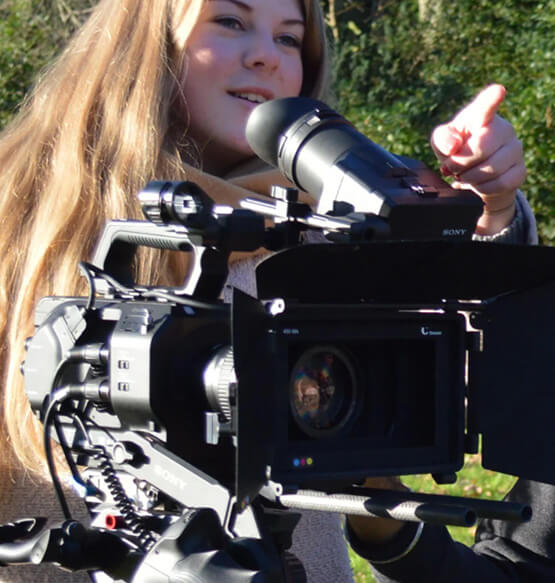
You’ll have access to ARRI Alexa and Amira, Blackmagic and Sony cinema cameras, XEEN Primes and Zeiss Compact Primes, wireless follow focus systems and Teradek wireless video transmission.
Our lighting equipment includes Aputure 600x, Nova P300c and F22c lights, Astera Titan Tubes and ARRI fixtures.
Facilities include two film studios, two sound studios, 11 editing suites with Premiere Pro, four dedicated colour grading suites with DaVinci Resolve, and a 5.1 surround sound mixing suite with Pro Tools. There are also filming locations across campus.

Josh Appignanesi
is Programme Leader of the MA Filmmaking. A writer/director with seven feature films, and many shorts, videos and commercials to his name, he's worked with talent including John Malkovich, Tom Hiddleston, David Tennant, and Michelle Dockery, writers like Zadie Smith and John Berger, musicians like OMD and Orlando Weeks, and Turner-Prize winning artist Martin Creed.
His most recent feature film, COLOSSAL WRECK about the COP climate conferences, was shown at COP30 in Brazil. Prior to that, climate activist documentary MY EXTINCTION was released in 50 cinemas as well as at the Glastonbury Festival. Prior features include the docufiction HUSBAND (In Competition, Edinburgh Film Festival 2022), surrealist psychothriller FEMALE HUMAN ANIMALpremiering at Sheffield Doc/Fest, and parenting documentary THE NEW MAN.His films were all widely-reviewed and theatrically released and have streamed in over 100 countries on platforms like MUBI, Curzon Home Cinema, Amazon Prime, and BFIPlayer.
He also directed the award-winning, David Baddiel-scripted comedy feature THE INFIDEL,starring Omid Djalili, Richard Schiff, Matt Lucas, Miranda Hart and Archie Panjabi; and co-wrote Sarah Jessica Parker rom-com ALL ROADS LEAD TO ROME
His debut feature was psychological drama SONG OF SONGS (BIFA nominated, In Competition Rotterdam, London, Edinburgh)
A BAFTA and BIFA jury member, he sits and advises on various industry bodies, and has taught at London Film School, the Met Film School, Guardian Masterclasses, Film London and Roehampton University, where he is an Associate Professor in Film.

Dr Muriel Tinel-Temple
Programme Leader
Dr Tinel-Temple was educated in France and has been teaching in UK universities for over a decade. She teaches courses about film and screen cultures focusing notably on independent, alternative and experimental practices.
She also encourages and supervises students in their individual and creative practice, using all type of formats, including audio-visual essays, music videos, video installations, and the innovative re-use of archival material.
An active researcher, she has published books on self-portrait in the moving-image, notably on early video works, and articles on the creative use of found footage and self-reflexive films.
Dr Tinel-Temple organises film-related events, with her first experience being for the Cannes Film Festival, where she supervised the promotion and distribution of short works by emerging filmmakers.
Since then, Dr Tinel-Temple has collaborated with LUX in London and Light Cone in Paris to curate programmes, and co-organised study days and screenings in 8mm and 16mm for Birkbeck Institute for the Moving Image.
More recently, Dr Tinel-Temple organised UK premiere screenings of the work of Jacques Perconte and his Digital Landscapes.

Professor Michael Witt
Professor Michael Witt’s main teaching and research interests lie in the fields of experimental filmmaking, documentary, essay films and video essays, film history and theory, and French cinema.
He has worked closely with many national and international cultural institutions, and curated major film seasons devoted to documentary, experimental cinema, and the films of Jean-Luc Godard for London-based venues such as BFI Southbank and Tate Modern.
Professor Witt holds a PhD in film and television studies and has taught film at Roehampton for over 25 years. In 2017, he looked back on his experience of supporting Roehampton students to create digital audio-visual essays as part of their studies in an illustrated article published in the online European film/media journal NECSUS.
He has published several books on aspects of cinema history, as well as film reviews, articles and interviews in magazines such as Sight and Sound.
He has a particular interest in Godard’s work, and is the author of Jean-Luc Godard, Cinema Historian (Indiana University Press, 2013), which was awarded the 2014 Limina Award for Best International Film Studies Book. His other books include The French Cinema Book, co-edited with Michael Temple (2nd edition, BFI Publishing/Bloomsbury, 2018).
https://pure.roehampton.ac.uk/portal/en/persons/michael-witt

Dr Deborah Jermyn
Associate Professor
Dr Jermyn has presented her work to a range of international public, media, and academic audiences, from the BFI Southbank to the Melbourne Women in Film Festival.
She is an author and editor of 11 books engaging with popular film and media in varied ways, including analyses of real-crime TV, audience studies, the growth of reality television, and contemporary celebrity culture.
Many of her teaching and writing interests have focused on women filmmakers, including the books Nancy Meyers (2017) and Hollywood Transgressor: The Cinema of Kathryn Bigelow (2003), with current projects examining the films of Gina Prince-Bythewood and Nicole Holofcener.
In recent years, she has been internationally recognised for her work on ageing/society/media which extends across both fiction and documentary film to encompass advertising, social media and digital platforms, and was nominated for a MeCCSA Outstanding Achievement Award in 2024 for her work in this area.
Dr Jermyn came to academia from a background in media publishing, press and publicity and, in addition to being part of the BA Film Production team, she is Deputy Research Degrees Convenor for the School of Arts and Digital Industries at Roehampton.
Read more about Deborah’s work at: https://pure.roehampton.ac.uk/portal/en/persons/deborah-jermyn

Dr Karine Chevalier
Senior Lecturer
Dr Chevalier's main expertise lies in the field of French Cinema, Transnational Cinema, Visual Arts and Aesthetics, Francophone Postcolonial Studies, Interdisciplinary and Transcultural Creativity, as well as Filmmaking.
She has extensive experience in teaching low-budget filmmaking, film history and criticism, transcreation, transnational creative project and screenwriting at underground/postgraduate level.
Dr Chevalier holds a BA in Film Practice and Aesthetics, an MA in Research on the Imaginary and a Ph.D in Comparative Literature.
She has published two monographs on memory from both imaginative and cultural perspectives as well as numerous articles about cinema (Bertrand Bonello, Celine Sciamma, Chantal Akerman, Jean Gremillon, Georges Franju, Tony Gatliff, Orson Welles).
The main focus of her multidisciplinary approach as researcher and filmmaker is about the use and representation of Masks, minority voices and resistance in a transglobal world, gender performances, and the representation of violence and its link to the experience of resilience.
Other interests include the Arts, Intermediality, Broken Faces, Youth in Cinema, Cinema from Corsica, Iranian cinema, the Carnival and digital inclusiveness.
https://www.institut-francais.org.uk/events-calendar/whats-on/workshop/french-film-club/

Alexandra Sage
Senior Lecturer
Alexandra graduated with an MA in Film Production (Fiction) from the Northern School of Film Television, and prior to that worked for the Arts Council of England funding artists’ film and video and managing joint production schemes with broadcasters.
In addition, she has designed and managed accredited practical filmmaking courses for organisations including Four Corners Film and the BBC. Her first degree is an MA in English Literature from the University of Edinburgh.
Her skills cover all areas of independent production, with particular expertise in teaching documentary production and critical theory (particularly contemporary practice, experimental and hybrid forms), and sound design. She works closely with students to support group and solo work that has frequently received recognition in the form of awards, and public screenings at festivals and events.
Alexandra lectures on a wide range of BA Film Production modules at undergraduate and postgraduate level and is actively involved in the independent production scene regularly giving talks and appearing on panels at festivals, events and conferences.
She is currently in the post-production stage of an experimental semi-autobiographical documentary New York Stories, exploring the legacy of childhood, location and memory, set in 1960s Manhattan.

Mark Lever
Technical Instructor
Hello, I'm Mark and I am a Technical Instructor on BA Film Production. I have always had a passion for filmmaking and have worked on various projects, including a fan-made episode of Doctor Who and a time travel short film called 'Extra Time.' As a seasoned professional in the field, I love sharing my experience with others. I specialise in teaching workshops on Cinema Cameras, Audio, Lighting, and Video Editing.

Suleman Mahmood
Suleman Mahmood has five years of cinematography experience and collaborated with prestigious clients like Google, UNDP, and USIP. Proficient in handling industry-standard equipment such as ARRI Alexa Mini, RED Epic 8K, Blackmagic, he has contributed to diverse projects including feature films, short films, documentaries, music videos, commercials and educational courses. Notable achievements include Best Film and Best Cinematography for my film, where he served in multiple roles and garnered recognition at international film festivals.

Ross Bennett
Technician Instructor
Ross Bennett brings over 15 years of experience in the film industry to his role as a technical instructor. His background includes work on feature films, documentaries, music promos, commercials, and corporate videos. Ross also spent several years in the rental sector as a technician and engineer, gaining extensive knowledge of nearly all modern industry equipment. In addition, he has expertise in video editing and post-production, along with a strong interest in analogue photography.

Assessment
Push yourself further with real-world assignments.
Encompassing film productions, pitches and presentations, you’ll be set authentic assessments based on industry-standard briefs, so that your projects, tasks and exercises will replicate the working world of film production and its sister industries, ensuring that you are fully prepared for life after graduation.
Careers
As a graduate you will be equipped to enter various roles in the film, TV, advertising and content industries, such as:
· Film Director
· Producer
· Cinematographer
· Film Editor
· Screenwriter
· Production Designer
· Sound Designer/Editor
· Location Manager
· Production Manager
· Programme researcher
· Sustainability officer
· Digital content creator
· Sales and Marketing positions
· Impact producer
These roles are supported by the development of core skills through specialised modules focusing on film production techniques.

The Student Futures team is here to support you throughout your time at Roehampton and beyond.
They offer services tailored to your needs, helping you take confident steps towards your future.
You’ll have access to a wide range of career workshops and events, where you can engage with employers and develop the skills you need to succeed in the workplace.
These opportunities will help you build your CV, prepare for interviews, and connect with successful Roehampton graduates who are thriving in their careers. You’ll also be able to engage with our partners across London and beyond.
Wherever you want to go in the future, you'll be preparing for the world of work from your very first day.
#1 in London for postgraduate students
WhatUni Student Choice Awards 2026
Open days
Get a real taste of our campus, community and what it’s like to study at Roehampton
Applying
Full-time UK postgraduate students apply through our direct application system.
Entry tariff
General entry requirements
Specific entry requirements
A degree in an arts/media-based subject that enables success in filmmaking.
International undergraduate students apply through our direct application system.
Entry tariff
General entry requirements
Specific entry requirements
A degree in an arts/media-based subject that enables success in filmmaking.
Fees and funding
UK students
Tuition fees
| Entry date | MA |
|---|---|
| September 2027 | £11,588 |
Prices shown are for the first year of your degree.
Funding your studies
We also provide other ways to support the cost of living, including on-campus car parking, hardship support and some of the most affordable student accommodation and catering in London.
International students
Tuition fees
| Entry date | MA |
|---|---|
| September 2027 | £19,549 |
Prices shown are for the first year of your degree.
Funding your studies
We also provide other ways to support the cost of living, including on-campus car parking, hardship support and some of the most affordable student accommodation and catering in London.

Need help or advice before applying?
Arts, Humanities and Social Sciences
Integrating the creative dynamism of arts and digital industries with the deep-rooted traditions of humanities and social sciences.