
Duration:
2 years (full-time)
Number of credits:
180
Start date(s):
January 2027
January 2028
Prepare for a rewarding career working as a confident, autonomous Physiotherapy practitioner with strong reasoning, communication and teamwork skills. You'll go on to work in varied settings across the NHS (community, hospital and primary care) and private practice.
Did you know?
Learning will take place in our state-of-the-art teaching facilities including the Mary Seacole Health Innovation centre equipped with advanced technology and equipment.
This programme is accredited by The Chartered Society of Physiotherapy (CSP)* and The Health and Care Professions Council (HCPC).

Modules
Year One
The aim of this module is to introduce you to the key concepts and core foundations of physiotherapy practice, and to help you integrate your knowledge with its application to clinical assessment as you continue to build your practical skills. You will develop a comprehensive understanding of the core concepts underpinning physiotherapy practice and begin to integrate theory with clinical application. You will study human anatomy and physiology, alongside the interaction of body systems across the lifespan, and the pathophysiology of common conditions encountered in physiotherapy. You will explore concepts of pain, healing, and the biopsychosocial model of health, recognising the influence of psychological and social factors. The module will also support the development of skills in movement analysis, safe handling, and clinical reasoning. Throughout the module, you will be encouraged to explore implicit bias and justify your decision-making processes and reasoning for your chosen approaches to assessment.
This integrated module brings together the core themes of professionalism, leadership, innovation, and personal development in contemporary healthcare practice. You will examine ethical and legal frameworks, codes of conduct, and the importance of interprofessional working. You will engage with leadership theories, service improvement approaches, and digital innovation in healthcare. Through reflective practice and skills development, you will build your capacity for lifelong learning, cultural competence, and evidence-informed leadership. The module supports your growth as an autonomous practitioner, enhancing your ability to lead, collaborate, and adapt within dynamic health and social care environments.
In this module, you will develop the research and analytical skills required to evaluate evidence and support evidence-based practice. You will explore qualitative, quantitative, and mixed-methods research, alongside principles of research design and data analysis. The module supports your ability to critically appraise scientific studies and apply findings to practice. You will also consider ethical issues in research, including participant involvement and data management. Through interactive learning, including lectures and practical sessions, you will gain experience in analysing and interpreting data, preparing you for future research activity and informed decision-making in healthcare.
In this module, you will explore the role of the physiotherapist in promoting health and wellbeing across the lifespan. You will develop a detailed understanding of exercise physiology and apply this knowledge in the context of exercise prescription. You will examine the impact of social, economic, and environmental determinants on health, consider how biopsychosocial factors influence physical activity and behaviour, and explore strategies to support sustainable lifestyle change. The module also introduces perspectives from psychology, sociology, and cultural diversity, helping you understand varied health experiences. You will develop skills in communication, teamwork, and interprofessional working, while considering approaches such as social prescribing and telehealth to support inclusive, person-centred care. You will also gain an appreciation of the value that other health professionals bring to promoting and supporting health and wellbeing.
Year Two
In this module, you will build on previously developed knowledge and skills to focus on treatment planning and rehabilitation for a range of conditions across the lifespan . You will explore evidence-based interventions and develop your ability to design and justify effective treatment approaches. Practical skills in handling and safe practice will be further enhanced. You will examine the impact of ageing, disease progression, and end-of-life care on rehabilitation needs, and consider how interventions influence functional and physiological outcomes. The module emphasises collaborative working and strategies to optimise patient engagement. Throughout, you will continue to strengthen key transferable skills, including communication, clinical reasoning, decision-making, and reflective practice.
In this module you will design and conduct an independent research project, this may be a scoping review, including literature review, data collection, analysis, and dissemination. This project will allow you to apply your research knowledge in a focused area of interest. You will develop skills in data collection, analysis, and critical evaluation, supported by lectures and seminars. The module also involves engagement with research ethics and methodological considerations. Through this process, you will strengthen your ability to conduct and communicate research, supporting your development as an evidence-informed practitioner.
Skills
Our MSc Physiotherapy (pre-registration) is a 2-year course which offers those with a relevant UG qualification an entry route into the Physiotherapy profession.
The programme will focus on supporting you to become a self-reflective lifelong learner, committed to inclusive practice, continuing professional development and personal and professional development who will meet the requirements of Physiotherapy’s professional statutory regulatory bodies: The Health and Care Professions Council (HCPC) and The Chartered Society of Physiotherapy (CSP).
Learning
Learn in a stimulating and active environment.
The programme will provide a stimulating and active learning environment to engage and motivate you to become a confident, autonomous practitioner with effective communication and teamwork skills for practice in varied health and social care settings.

Our programme offers a blended learning approach which includes online learning and in-person teaching. The course is modular which creates a spiral curriculum for knowledge and skills to be scaffolded and built upon as you progress through the programme and develop proficiency.
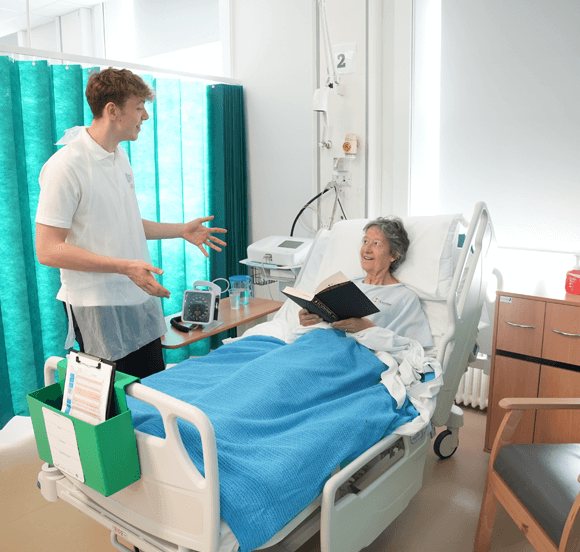
You will undertake placements in a wide range of settings across different clinical areas, and in education, research and leadership to reflect current health and social care provision.
The programme will integrate university-led modules with practice-based learning that includes simulated placements and external placements, in a wide range of settings to encourage advanced scholarly thinking alongside an evidence-based approach to person-centred care.
The School of Life and Health Science is a progressive and inclusive community, that places you, the student, at the centre of the learning journey. We recognise that our students have different personal circumstances, and we are committed to supporting you as individuals throughout your studies and helping you succeed in completing your course to the very best of your ability while balancing work, family, and other external commitments.
Career
Shape the future of health and social care.
The University-led modules and practice-based learning on the course will help build a wide base of knowledge and develop key transferable skills which will prepare you for a career in physiotherapy upon graduation. Diverse employment opportunities include the following:
- General practice
- Community Services
- Professional sport
- Private practice
- National Health Service (NHS)
- The third sector
- Education
- Research
- Leadership
The transferable skills developed through the course will also support graduates for a diverse range of careers outside of physiotherapy.
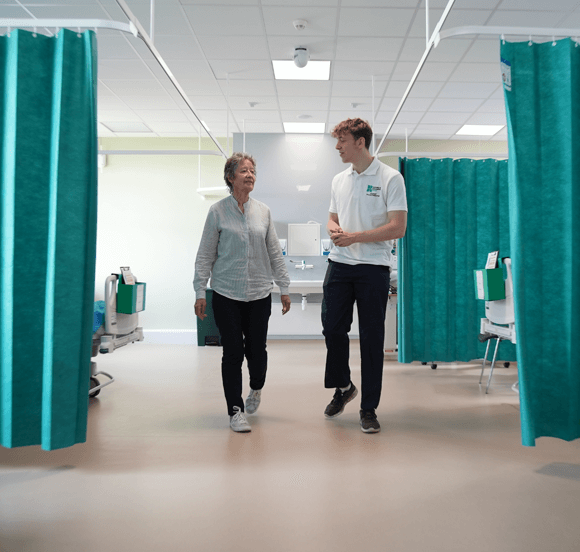
Our careers team is available to support you from the start of your studies until after you graduate. We will help you build your CV, prepare for interviews, and meet and learn from successful graduates working at the top of their careers. You’ll also have opportunities to work with our partners across London and beyond, and to attend a Roehampton jobs fair where you can find out about graduate opportunities and meet employers.
The Student Futures team is here to support you throughout your time at Roehampton and beyond.
They offer services tailored to your needs, helping you take confident steps towards your future.
You’ll have access to a wide range of career workshops and events, where you can engage with employers and develop the skills you need to succeed in the workplace.
These opportunities will help you build your CV, prepare for interviews, and connect with successful Roehampton graduates who are thriving in their careers. You’ll also be able to engage with our partners across London and beyond.
Wherever you want to go in the future, you'll be preparing for the world of work from your very first day.
#1 in London for postgraduate students
WhatUni Student Choice Awards 2026
Open days
Get a real taste of our campus, community and what it’s like to study at Roehampton
Applying
UK postgraduate students apply through our direct application system.
Specific entry requirements
GCSE Grade C/4 in mathematics, science and english, plus UK undergraduate honours degree at 2.2 or above, or equivalent international qualification, in a relevant subject. Relevant subject areas include biological sciences, sport science, sports therapy or rehabilitation, chemistry, nursing and psychology.
Other degrees will be considered on an individual basis.
Applicants will need to demonstrate evidence of interest and work experience in a relevant field and will also need to supply a satisfactory enhanced DBS check.
Applicants must undergo health screening to assess fitness to begin the course. Applicants must also complete an approved programme of immunisation, as recommended by the Department of Health.
All applicants will undertake a values-based interview.
Non-native English speakers who do not have GCSE English or equivalent at grade 4/C or above require an IELTS score of at least 6.5 in writing and at least 7.0 in reading, listening and speaking, with a minimum overall score of 7.0. Please refer to the HCPC website for more details.
General entry requirements
International postgraduate students apply through our direct application system.
Specific entry requirements
GCSE Grade C/4 in mathematics, science and english, plus UK undergraduate honours degree at 2.2 or above, or equivalent international qualification, in a relevant subject. Relevant subject areas include biological sciences, sport science, sports therapy or rehabilitation, chemistry, nursing and psychology.
Other degrees will be considered on an individual basis.
Applicants will need to demonstrate evidence of interest and work experience in a relevant field and will also need to supply a satisfactory enhanced DBS check.
Applicants must undergo health screening to assess fitness to begin the course. Applicants must also complete an approved programme of immunisation, as recommended by the Department of Health.
All applicants will undertake a values-based interview.
Non-native English speakers who do not have GCSE English or equivalent at grade 4/C or above require an IELTS score of at least 6.5 in writing and at least 7.0 in reading, listening and speaking, with a minimum overall score of 7.0. Please refer to the HCPC website for more details.
General entry requirements
Fees and funding
UK students
Tuition fees
| Entry date | MSc |
|---|---|
| January 2027 | £9,790 |
Prices shown are for the first year of your degree.
Funding your studies
We also provide other ways to support the cost of living, including on-campus car parking, hardship support and some of the most affordable student accommodation and catering in London.
International students
Tuition fees
| Entry date | MSc |
|---|---|
| January 2027 | £18,980 |
Prices shown are for the first year of your degree.
Funding your studies
We also provide other ways to support the cost of living, including on-campus car parking, hardship support and some of the most affordable student accommodation and catering in London.

Need help or advice before applying?
Life and Health Sciences
Join our diverse Life and Health Sciences community, whose leading academics are dedicated to understanding and improving the living world through ground-breaking advances in scientific research.


