
Duration:
1 year (full-time)
Please add an additional year if undertaking Professional Experience Year
Number of credits:
180 credits at level 7
Start date(s):
September 2026
November 2026
January 2027
March 2027
May 2027
July 2027
September 2027
If you are an ambitious professional ready to accelerate your career, transition into senior leadership, or develop the financial expertise needed to lead in a global business environment, our MBA with Finance is for you.
Designed for aspiring managers, consultants, finance professionals and entrepreneurs, this course combines advanced leadership development with applied financial knowledge to prepare you for senior roles where strategic and financial judgement are critical.
You will gain a comprehensive understanding of core business functions, including strategy, finance, leadership, marketing, and organisational management, while developing specialist expertise in areas such as sustainable finance, global markets, financial analysis, and AI-enabled decision-making. Through an applied learning approach that blends case-based teaching, experiential projects, and industry-informed practice, you will build the analytical capability, commercial awareness, and confidence required to lead in complex and fast-changing organisations.
Based in London, one of the world’s leading financial centres, the course offers valuable exposure to international business and finance, making it an attractive choice for both UK and international students seeking a practical and career-focused route into leadership roles.

Why study this course?
- You will develop a comprehensive understanding of business leadership alongside advanced financial expertise, preparing you for senior management, consultancy, finance leadership, and entrepreneurial roles
- You will explore contemporary topics including sustainable finance, global financial markets, and technology-driven decision-making
- You will strengthen your strategic, analytical, and evidence-based decision-making skills through real and simulated business challenges
- You will be taught by academics and industry practitioners with extensive professional experience, ensuring your learning is relevant, contemporary, and practice-focused
- You will engage in hands-on, applied learning that reflects real professional environments and prepares you to lead with confidence in a global marketplace
- Studying in London gives you access to one of the world’s most dynamic financial and business hubs, where the city becomes an extension of your learning experience
Modules
30 credits
This module aims to equip you with the knowledge and methods necessary to address pressing strategic, social and ethical challenges businesses face.
It provides a critical understanding of Corporate Strategy and Corporate Social Responsibility (CSR) in an international context. You will learn to apply strategic concepts and tools essential for managers in multinational firms, with a focus on sustainability practices influencing business policy and stakeholder relationships. Additionally, the module emphasises the importance of data-driven decision-making and non-market strategic management, preparing future professionals to navigate the complexities of modern business environments.
The module provides a number of essential frameworks to guide future managers in analysing the main factors relevant to the strategy-making process. These frameworks are designed to offer a structured approach to strategic analysis, ensuring that all critical aspects are considered. Real-world case studies and insights from leading corporations will be utilised to illustrate the practical application of the strategic frameworks.
All business operations transpire within a complex social landscape, and non-market aspects play a significant role in strategic management. This includes political, economic, and environmental issues that can impact organisational success. The module highlights the importance of understanding these non-market factors and incorporating them into strategic planning.
You will learn how to analyse and address social and ethical issues that businesses face today. This includes topics such as corporate governance, ethical leadership, and social justice. By understanding the broader impact of business decisions, you will be able to foster a more ethical and responsible business culture.
Teaching and learning
You will gain a comprehensive understanding of strategic decision-making and how to apply it within business contexts. Each week, you will participate in a carefully organised learning experience comprising of a one-hour lecture and a three-hour workshop.
Lectures will introduce and elaborate on key concepts and frameworks pertinent to strategic decision-making. These sessions are designed around the indicative course content, aiming to give you a solid theoretical foundation. The lecture topics will encompass a broad spectrum of examples and case-based learning drawn from business practices and societal contexts to demonstrate the practical applications of these concepts. This approach ensures that you can relate theoretical knowledge to real-world scenarios, thereby enhancing comprehension and retention of the material.
Workshops will delve deeper into the theoretical approaches, exploring detailed business cases. You will examine various scenarios that are likely to arise in organisational, management, and business situations.
You will engage with real-life case studies, where you will learn to navigate complex ethical issues and make informed decisions that are both strategic and responsible. You will explore global sustainability challenges and opportunities, learning how to drive innovation through sustainable practices and responsible leadership.
You will also have 30 minutes of online support, which will include resources such as articles, videos, interactive modules and quizzes.
Assessment
This module will be assessed using two individual coursework components.
30% Poster presentation (500 words), where you will analyse and present a chosen strategic problem.
70% Executive report (3,500 words), where you will provide evidence-based recommendations in response to a strategic challenge within a case study organisation.
30 credits
Get equipped you with the theoretical knowledge and practical skills to evaluate corporate financial strategies and make evidence-based investment decisions. You will explore how organisations raise capital, manage financial resources, and assess investment opportunities in both domestic and international contexts.
The module introduces you to financial markets and institutions, short and long-term planning, and valuation methods for corporate bonds and equity. You will then progress to advanced topics such as capital structure decisions, cost of capital estimation, and strategic investment appraisal, using techniques like NPV, IRR, and project risk assessment. Through real-world case studies, you will analyse corporate financial scenarios and propose strategic recommendations that balance financial return with risk.
By the end of this module, you will have the ability to critically evaluate financial data, assess investment opportunities, and make informed strategic recommendations. These skills are directly relevant to roles in corporate finance, investment banking, and consultancy, as well as further academic study in finance-related disciplines.
Teaching and learning
A blended learning approach ensures that you develop both analytical and applied skills. Interactive workshops, case study analysis, and collaborative problem-solving will strengthen your ability to apply theory to practice, while digital resources and simulations will enhance your technical competencies.
Teaching is delivered through weekly workshops supported by 30 minutes of online digital content. In the workshop, you will deepen your understanding of corporate finance principles, financial markets, institutions, valuation techniques, and risk management, with real-world cases providing industry relevance.
Sessions are interactive and practice-focused, including quantitative exercises, case studies, investment appraisal simulations, and risk assessment tasks. You will engage in discussions and problem-solving activities to strengthen your ability to evaluate financial data and make informed decisions in global, technology-driven contexts.
Online resources and Moodle materials complement the workshops, supporting independent study and ensuring a flexible, comprehensive learning experience.
Assessment
This module will be assessed by a presentation (30%) and a case study report. (70%).
30 credits
This module aims to equip you with the essential knowledge and a profound understanding of financial performance management concepts and techniques, and their application, enabling you to make informed financial decisions in organisations across industries, sectors, and geographic areas.
Topics include the nature and purpose of financial management, financial reporting and communication, financial statement analysis, ratio analysis, balanced scorecard, project appraisal techniques.
You will explore companies’ reporting tools, including annual reporting and sustainability reporting, assess companies’ financial and non-financial performance, and explore the use of financial and non-financial information to inform decision-making. You will explore companies’ external environment and focus on emerging challenges (including sustainability, sustainable development goals, artificial intelligence, economic crisis), and their effect on companies’ performance.
Throughout the module, you will engage in case study analysis and group discussions to contextualise theoretical concepts. Practical workshops will involve critical analysis of real cases, data collection and analysis, use of technology to enhance learning. You will also have the opportunity to work with others and communicate your ideas and recommendations effectively.
Teaching and learning
The teaching delivery for this module consists of one, two-hour lecture and one, two-hour seminar per week.
Lectures will cover key concepts and techniques used in financial management and will use a diverse range of examples and real cases to demonstrate the application of concepts and tools.
Seminars will focus on the application of theoretical knowledge to real cases. Seminars foster analytical skills, focusing on data collection and analysis. Seminars are interactive and provide a number of activities, including case studies, group discussion, quizzes, data collection.
You will also have 30 minutes of online support.
Assessment
This module will be assessed by an MCQ (30%) and a case study report (70%).
30 credits
This module explores the intersection of financial innovation and sustainability, preparing you to navigate the rapidly evolving landscape of responsible finance. You will study the structure and mechanisms of sustainable finance alongside the disruptive potential of financial technologies (FinTech).
The module introduces you to sustainable finance regulations, ESG disclosure initiatives, and green equity and debt markets, before progressing to advanced FinTech applications such as blockchain, cryptocurrencies, and AI in finance. You will also examine the risks and opportunities created by digital disruption, including global regulatory perspectives and issues of financial inclusion. By combining sustainability and technology, the module positions you to analyse how finance can contribute to the UN Sustainable Development Goals (SDGs).
By the end of this module, you will be able to critically evaluate sustainable finance strategies, apply emerging technologies to financial problems, and communicate solutions effectively to both professional and academic audiences. These skills will prepare you for careers in financial analysis, ESG investing, and FinTech innovation, as well as further research in the field.
Teaching and learning
Hands-on learning is central to the module, with opportunities to engage with industry-standard tools such as Bloomberg terminals and to pursue Bloomberg certification. You will complete case studies and simulations that require you to integrate financial and non-financial information into investment decision-making, ensuring you gain applied technical skills alongside theoretical understanding.
You will take part in weekly workshops, supported by 30 minutes of online digital content. These sessions combine lectures and seminars to build your knowledge of sustainable finance and financial technologies, using real-world examples to show how concepts apply in practice.
Interactive seminars focus on analysis and application through discussions, quizzes, case studies, and quantitative tasks. You will learn how to integrate financial and non-financial factors, including environmental, social, and governance considerations, into decision-making for diverse and technology-driven contexts.
Online resources and digital tools, including Bloomberg activities, will enhance your skills and provide opportunities to apply your knowledge. Independent study using module resource lists, readings, and Moodle materials is an essential part of the learning process.
Assessment
This module will be assessed by a group presentation (30%) and a case study report (70%).
30 credits
In this module you will work in cross-disciplinary teams to solve a real strategic challenge set by a London-based organisation. Applying the knowledge and skills developed throughout your programme, you will analyse complex business problems, evaluate evidence and develop practical recommendations for employers. Following a structured consultancy process, you will present your findings to a panel of academic and industry professionals, gaining valuable experience of collaborative problem-solving and professional communication. You will also complete an individual critical reflection, evaluating your contribution, considering different disciplinary perspectives, and identifying key insights to support your future professional development and leadership.
30 credits
In this module you will develop the knowledge, confidence and critical thinking needed to use artificial intelligence responsibly in professional settings. You will explore how AI works, understand its strengths and limitations, and evaluate AI-generated outputs with a critical perspective. Through hands-on projects using real AI tools, you will examine ethical issues such as bias, fairness and governance while considering discipline-specific challenges. You will also learn how to assess AI adoption, communicate complex AI concepts to non-specialist audiences, and make informed decisions in AI-augmented workplaces, drawing on real-world examples from London's leading industries and professional sectors.
These are the current planned modules on this course and may be subject to change.
Professional Experience Year
This course also offers the option of a Professional Experience Year. This programme combines dynamic career modules with flexible placement opportunities. After completing your first year of study, you'll then spend the next academic year completing your Professional Experience training as part of your degree. This will give you real career experience. This unique opportunity offers you distinct paths to build your expertise.
This compulsory module provides a common academic foundation for all PEY students. It focuses on career development, professional communication, workplace expectations, collaboration, digital capability, professional behaviours and reflective practice.
Following successful completion of Career and Professional Immersion, students will progress to one of two 30-credit professional experience modules:
- Professional Placement
- Group Internship Experience
Students undertake a minimum 30-week professional placement within an approved external organisation. The module focuses on sustained professional practice, application of postgraduate knowledge and skills, professional responsibility, workplace contribution, feedback and critical reflection.
Students undertake two sequential structured group internships across the professional experience period, responding to authentic organisational or industry challenges. The module focuses on collaborative professional practice, project management, research and analysis, client/stakeholder engagement, development of professional outputs, feedback and critical comparison of learning across the two internship experiences.
Careers
You'll be equipped to excel in leadership and finance-focused roles across a wide range of industries and global organisations.
Our MBA with Finance prepares you to lead with confidence in complex business environments, combining strategic management capability with advanced financial expertise to support long-term career progression.
Career paths include:
- Finance leadership: Roles such as finance manager, corporate finance associate, or senior manager within financial services organisations.
- Financial analysis and consulting: Careers including investment analyst, financial consultant, or strategy and management consultant.
- Commercial and operational leadership: Positions such as business development manager, operations director, or commercial director across a range of sectors.
- Entrepreneurship: Launching or growing businesses with the strategic and financial insight needed to succeed in competitive markets.
- Strategic management: Leading organisational growth, transformation, and decision-making within national and international businesses.

The Student Futures team is here to support you throughout your time at Roehampton and beyond.
They offer services tailored to your needs, helping you take confident steps towards your future.
You’ll have access to a wide range of career workshops and events, where you can engage with employers and develop the skills you need to succeed in the workplace.
These opportunities will help you build your CV, prepare for interviews, and connect with successful Roehampton graduates who are thriving in their careers. You’ll also be able to engage with our partners across London and beyond.
Wherever you want to go in the future, you'll be preparing for the world of work from your very first day.
The Student Futures team is here to support you throughout your time at Roehampton and beyond.
They offer services tailored to your needs, helping you take confident steps towards your future.
You’ll have access to a wide range of career workshops and events, where you can engage with employers and develop the skills you need to succeed in the workplace.
These opportunities will help you build your CV, prepare for interviews, and connect with successful Roehampton graduates who are thriving in their careers. You’ll also be able to engage with our partners across London and beyond.
Wherever you want to go in the future, you'll be preparing for the world of work from your very first day.
#1 in London for postgraduate students
WhatUni Student Choice Awards 2026

Learning & assessment
You will engage with real and simulated business challenges that require you to analyse complex organisational situations and develop informed, evidence-based solutions. This approach will strengthen your strategic thinking, problem-solving, communication, and professional decision-making skills.
The course combines case-based learning, applied problem-solving, and professional practice to help you connect theory with real organisational challenges. You will learn through a blend of lectures, workshops, seminars, simulations, and live or practice-based projects that reflect contemporary business and financial environments.
Throughout the programme, you will take part in:
- Case-based learning and business simulations
- Applied problem-solving activities
- Live and practice-based industry challenges
- Workshops, seminars, and collaborative learning
- Professional and industry-informed learning experiences
The programme is delivered through a focused timetable with structured learning activities before, during, and after taught sessions, supporting active engagement, independent thinking, and reflective learning.
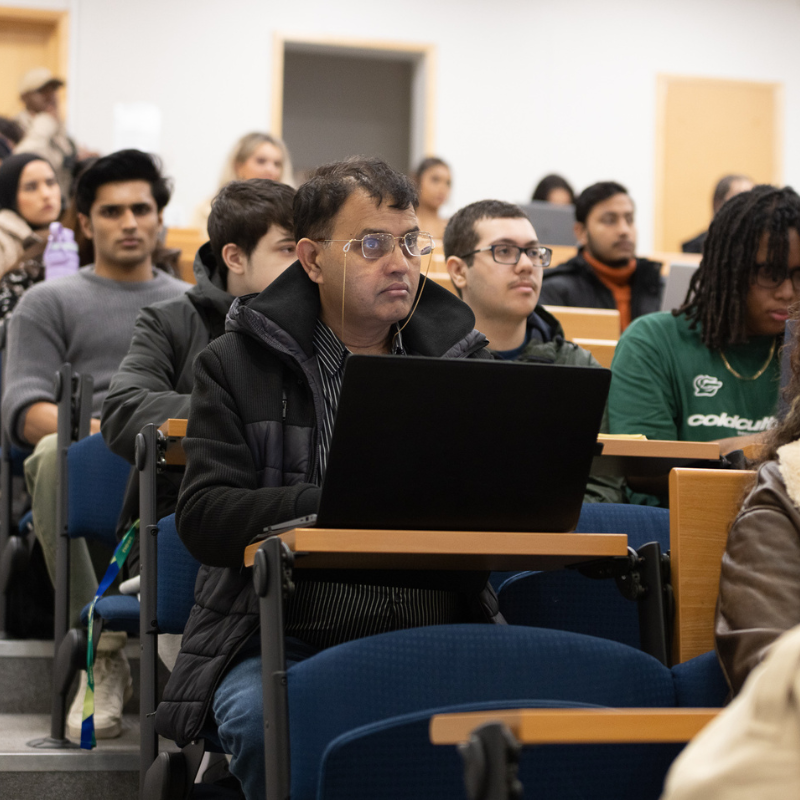
Block mode teaching
This course will be taught in dedicated blocks.
This innovative approach means that you will be taught in six-week blocks that focus exclusively on one module at a time. You will be able to fully immerse yourself in each topic and apply your learning effectively. There is also flexibility to join at any entry point within the cycle of this course.
Each module block includes eight teaching hours (lectures and practical workshops) each week, over two days.
- You can focus on one subject at a time, maximising your understanding, retention and application of knowledge
- Reduce the stress of juggling multiple subjects at once
- A clear timetable making it easier to balance academic commitments with personal life
- Dedicated days to delve into each topic without distraction
- Focus on one assessment at a time at the end of each block
- Eliminates the pressure of multiple end-of-term assessments
- Regular tasks are integrated into each block, ensuring timely feedback and continuous improvement
- A modern, practical way to learn that prepares you for your career goals.
- Induction week – you will be introduced to the subject, the course team and other students on the module
- Six weeks of teaching – deep dive into content led by subject experts, utilising research informed teaching, practical case studies, group work and hands-on projects
- Assessment week – each block will end with a focused assessment where you can apply your knowledge to real-world cases
How you'll be assessed
Assessment on this course is designed to reflect the challenges and expectations of contemporary professional practice. You will complete a range of authentic and industry-relevant assessments that test both academic understanding and practical application.
Throughout the programme, you will take part in assessments such as:
- Business and financial reports
- Presentations and pitches
- Consultancy-style briefs
- Data-informed analysis and problem-solving tasks
- Portfolios and project-based outputs
These assessments are designed to develop the professional communication, analytical, strategic, and decision-making skills valued by employers across business and financial sectors.
The final applied project or business challenge will give you the opportunity to integrate your learning across the programme, apply your knowledge to a realistic organisational context, and produce recommendations with professional and practical value.
Open days
Get a real taste of our campus, community and what it’s like to study at Roehampton
Applying
UK postgraduate students apply through our direct application system.
General entry requirements
International postgraduate students apply through our direct application system.
General entry requirements
Fees and funding
UK students
Tuition fees
| Entry date | MSc |
|---|---|
| September 2026 | £16,640 |
| November 2026 | £16,640 |
| January 2027 | £16,640 |
| March 2027 | £16,640 |
| May 2027 | £16,640 |
| July 2027 | £16,640 |
Prices shown are for the first year of your degree.
Professional Experience Year
Students enrolled on programmes including a Professional Experience Year will be charged a tuition fee for the Professional Experience Year. For students commencing the Professional Experience Year during the 2026/27 academic year, this fee is £2,500.
Tuition fees are reviewed annually and may be subject to change in subsequent academic years in accordance with the University’s Student Fee Payment and Enrolment Regulations.
Funding your studies
We also provide other ways to support the cost of living, including on-campus car parking, hardship support and some of the most affordable student accommodation and catering in London.
International students
Tuition fees
| Entry date | MSc | Extended Masters (1 Semester) |
|---|---|---|
| September 2026 | £20,020 | £24,180 |
| November 2026 | £20,020 | – |
| January 2027 | £20,020 | £24,180 |
| March 2027 | £20,020 | – |
| May 2027 | £20,020 | £24,180 |
| July 2027 | £20,020 | – |
Prices shown are for the first year of your degree.
Professional Experience Year
Students enrolled on programmes including a Professional Experience Year will be charged a tuition fee for the Professional Experience Year. For students commencing the Professional Experience Year during the 2026/27 academic year, this fee is £2,500.
Tuition fees are reviewed annually and may be subject to change in subsequent academic years in accordance with the University’s Student Fee Payment and Enrolment Regulations.
Funding your studies
We also provide other ways to support the cost of living, including on-campus car parking, hardship support and some of the most affordable student accommodation and catering in London.

Need help or advice before applying?
Business and Law
Be part of a diverse learning community that values excellence, reflection, inclusivity, ethics and collaboration.


